When Chekhov Stops Playing on Our Nerves

Dear readers, would you risk going into a restaurant with someone outside luring you in with promises of “excellent food at low prices”? That is why I always treat press invitations to performances accompanied by nothing but glowing reviews with caution. This time my misgivings deepened when I read in the press dossier that, according to Jean-François Sivadier, “the plot is very simple, and the play could have been subtitled Chronicle of the Death of an Anti-Hero Foretold.” I also learnt from him that there are supposedly two versions of the play: “one more of a comedy, the other more of a drama.” This was followed by a summary of that supposedly very simple plot in a few sentences: “Married to Anna Petrovna, whom tuberculosis has condemned to die in the near future, and burdened with debts, Ivanov is no longer able to withstand adversity. Over four gripping acts, this ordinary man, a petty bourgeois from central Russia and a ruined landowner, sinks into a paralysing melancholy that leads him to watch his own downfall helplessly. The comic twists and turns that toss this anti-hero between renewal and stagnation turn his fate into a fascinating journey through the captivating labyrinth of the human soul.” And then: “Drawing on the work of one of the greatest poets of all time, this production resonates with a quotation from Gustav Mahler: ‘Tradition is not the worship of ashes, but the passing on of fire.’” And yet I went to the Théâtre de Carouge: the call of Chekhov outweighed all other considerations. All the more so because the production comes from Paris, and the translation is by André Markowicz and Françoise Morvan. Practically canonical.
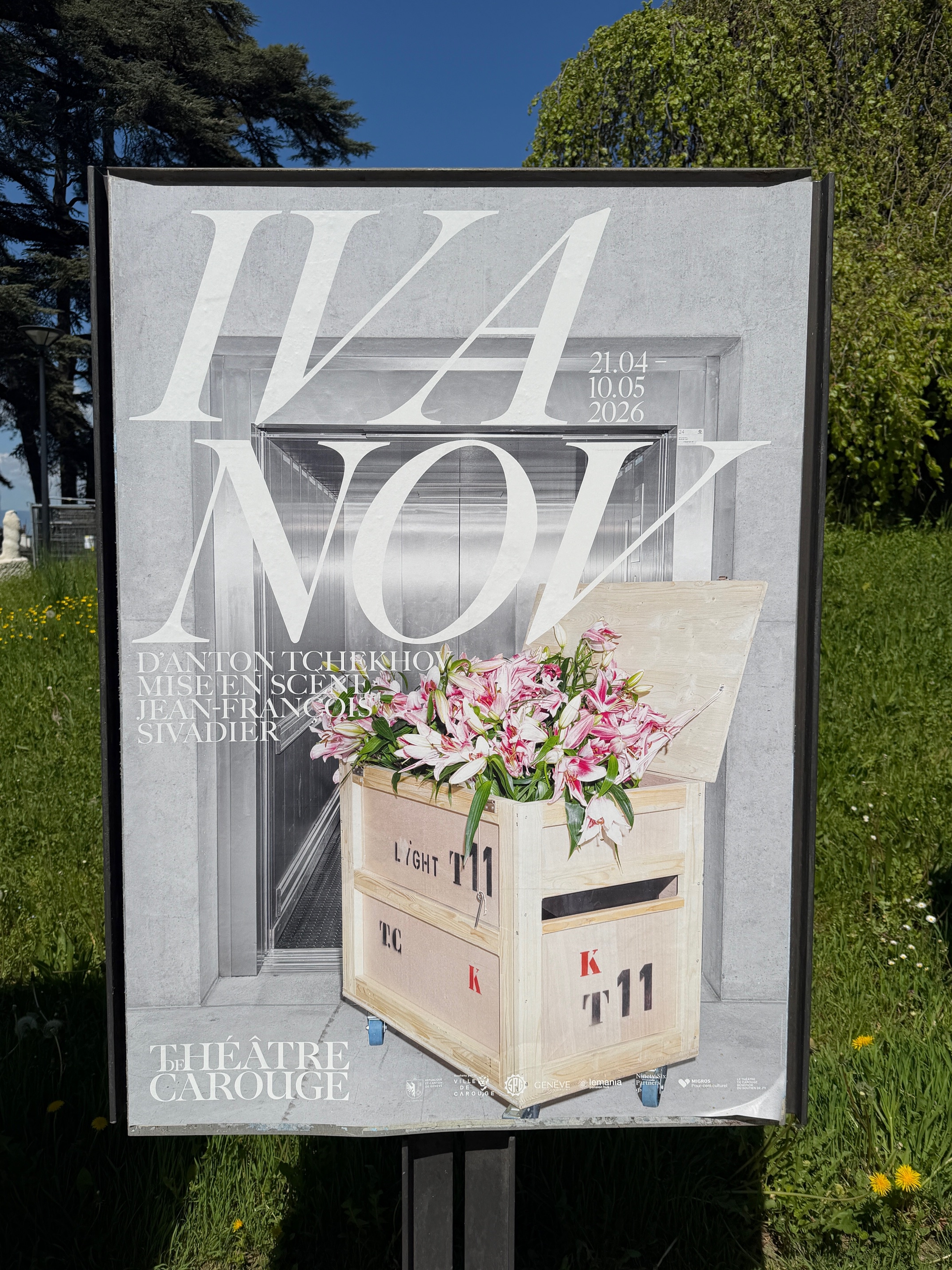
Now seriously. Let me begin by responding to the two quotations above. No, the plot is not simple: Chekhov has no simple plays, and simple plays do not remain on stage for 150 years or become classics. Cloaking one’s interpretation in Mahler is an original move, but the snag is that one has to have the fire in the first place. And this is not about “two versions”: there is one version, but different readings.
In 1887, at the age of twenty-seven, Anton Pavlovich Chekhov wrote Ivanov, his first play, in some ten days. He wrote it at the request of Fyodor Adamovich Korsh, a nobleman and professional lawyer who had devoted his life to the theatre and in 1882 founded the Russian Dramatic Theatre in Moscow, whose repertoire was dominated by comic farce. Presumably, with this repertory orientation in mind, the play was initially conceived as a comedy. But from one of Chekhov’s letters of that period we learn that Korsh’s request was supported by the actors as well: “The actors assure me that I shall write a good play, because I know how to play on people’s nerves.” But what sort of playing on the nerves can there be in a comedy? As the surviving original typescript shows, in the title Ivanov, a Comedy in 4 Acts and 5 Scenes, the word “comedy” was crossed out and above it Chekhov wrote, in his own hand, “drama”. It was precisely as A Drama in 4 Acts that the play passed the censor, underwent the revisions and was published in the journal Severny Vestnik (1889) and in all subsequent collections and editions of Chekhov’s works. This is a very important point, because both The Seagull and The Cherry Orchard remained comedies, although there is little to laugh at in either. Why?
“Modern dramatists begin their plays exclusively with angels, scoundrels and buffoons. Just try to find such elements in the whole of Russia! You will find them, to be sure, but not in such extreme forms as dramatists require... I wanted to be original: I brought on neither a villain nor an angel, though I could not refrain from buffoons; I accused no one and justified no one...” Anton Chekhov, 24 October 1887
Perhaps the answer lies in a letter Chekhov wrote to his elder brother Alexander, one of his most frequent correspondents, on 24 October 1887: “Modern dramatists begin their plays exclusively with angels, scoundrels and buffoons. Just try to find such elements in the whole of Russia! You will find them, to be sure, but not in such extreme forms as dramatists require... I wanted to be original: I brought on neither a villain nor an angel, though I could not refrain from buffoons; I accused no one and justified no one...”
As we can see, the urge to impose a black-and-white world on readers and audiences in keeping with the outlook of a given historical moment already existed in Chekhov’s day. Time, however, has shown that it is those who swim against the current who reach posterity. That is precisely Chekhov’s genius: he refused to see the world as “simple”, that is, primitive. He has no absolute angels, just as he has no complete villains, and every character in this extraordinarily subtle play shows us, the audience, first one side of themselves, then another, in direct speech. Psychology was not in fashion in Russia at the time, and yet every one of the dramatis personae could rival Freud, so precise, honest and merciless are their self-assessments. They are repellent to themselves, yet that does not prevent them from carrying on as before. And do we not sometimes recognise ourselves in them? That is precisely why the play provoked such violent and contradictory reactions from its earliest performances: critics reproached the author for the vagueness of his characters and could not decide in which category to place Ivanov, among the positive heroes or the negative ones. They still cannot.
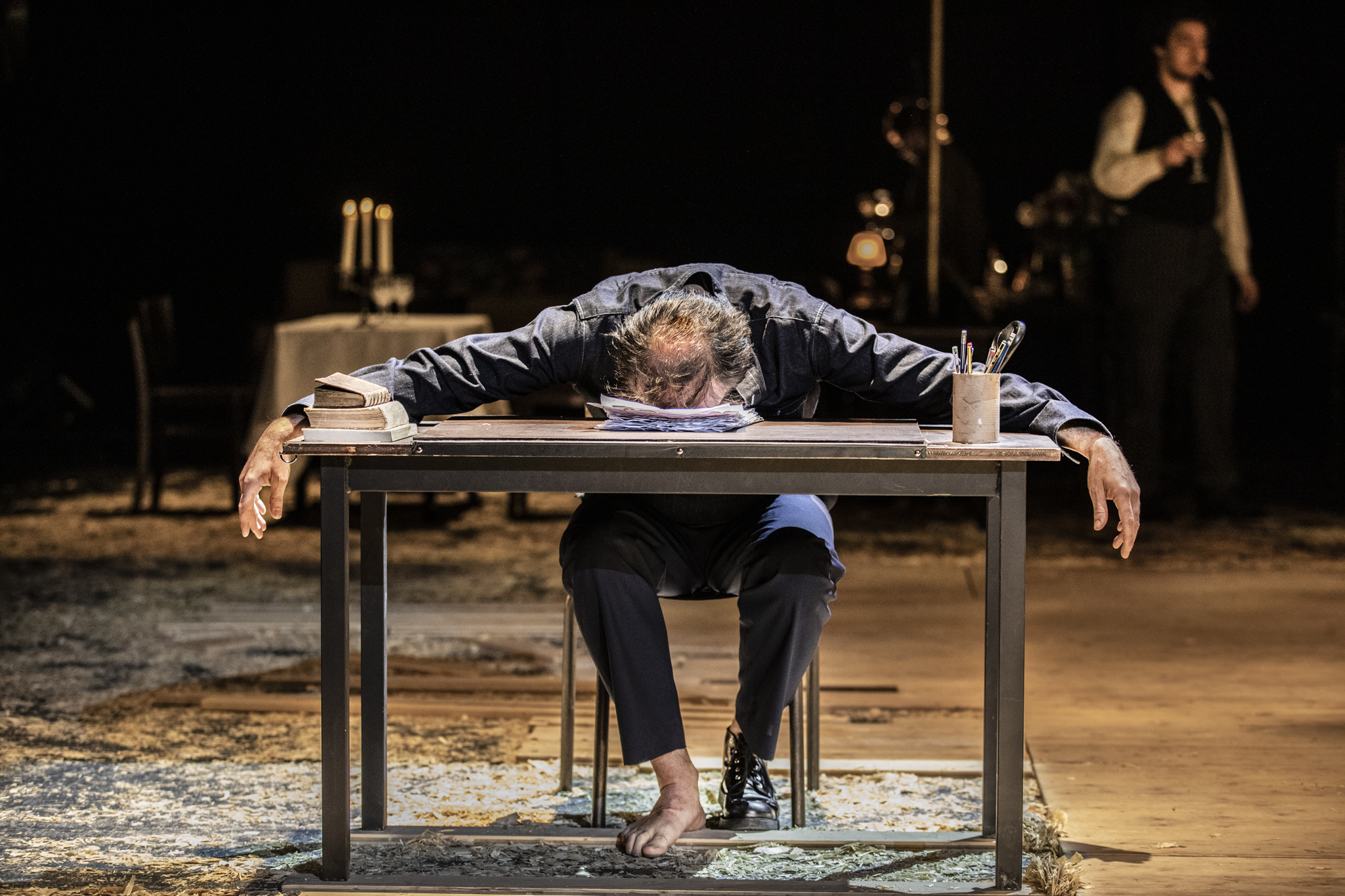
Jean-François Sivadier’s decision to present one of Chekhov’s bleakest plays as a comedy, evidently assuming that the audience would not endure a drama, is, of course, his personal choice. So too is his choice of one of the two versions of the ending, the one in which Ivanov’s heart simply stops, without suicide. Given the director’s reading of the play, that choice seems logical to me: Ivanov is too feeble a creature for suicide. (Incidentally, apparently to underscore the comic side of things, Ivanov appears before the audience in a T-shirt with comic strips on the back, which I was unable to make out. A complete period misfire.)
I do not know what percentage of the audience gathered in the Grand Hall of the Théâtre de Carouge for the first performance of Ivanov had read the play. I fear it was a very small one, which means that for the majority it was extremely difficult to grasp the point. If only because the programme lists only the characters and performers, without the author’s explanatory notes in the dramatis personae, so important for understanding who is who and how they are all connected.
Because this information is missing, the audience will not notice the age dissonance between certain characters and actors, which immediately struck me. Nikolai Alexeyevich Ivanov is only thirty-five, as he himself says in a monologue in the first act. In commenting on this character, Chekhov drew particular attention to the “weariness of life” in this still very young man and ironised about the lecture Ivanov delivers to Doctor Lvov on marriage: “Don’t marry, my dear fellow... Believe my experience.” By casting Nicolas Bouchaud, a fine actor, but one who is due to celebrate his sixtieth birthday this year, Jean-François Sivadier wipes out this nuance, which is so important for the author.
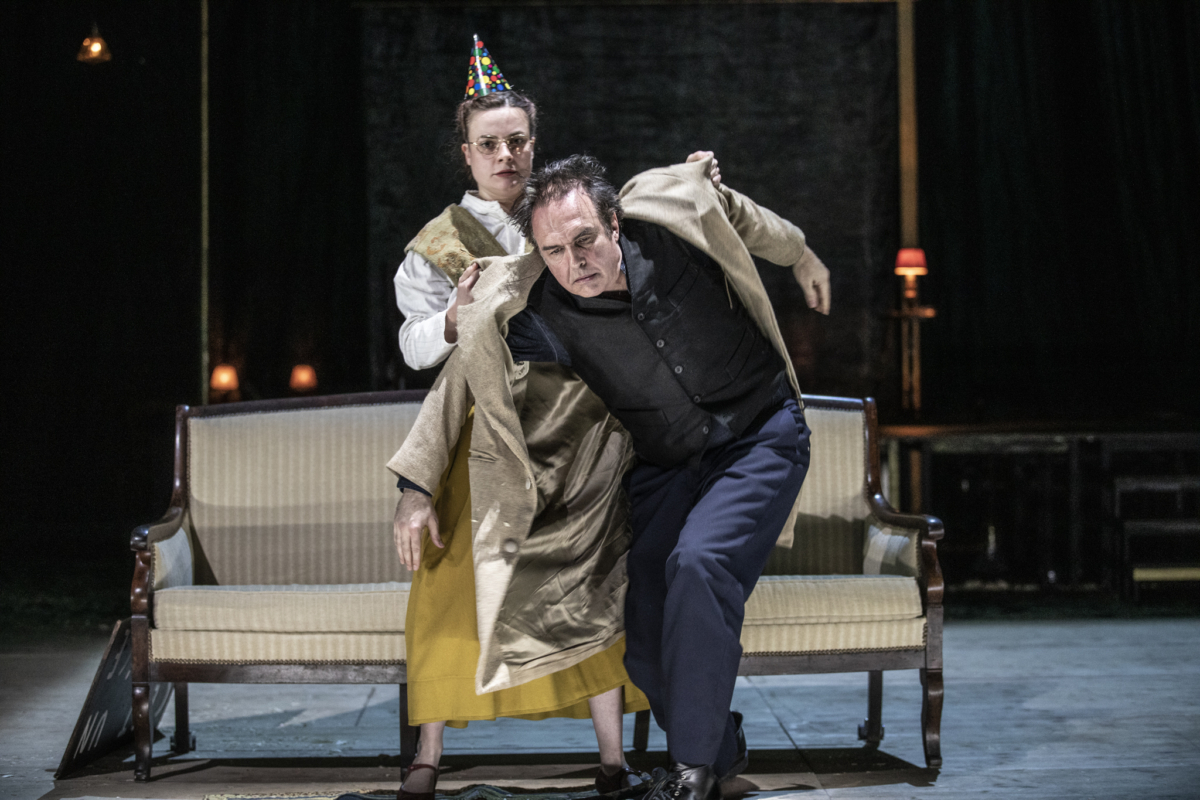
This also throws the Ivanov and twenty-year-old Sasha (played by Charlotte Issaly) pairing off balance: even a “girl of the new type”, in Chekhov’s definition, who has set herself the goal of “saving the unfortunate man”, would hardly have taken a fancy to someone outwardly old enough to be her father, a bore, and penniless into the bargain. Jean-François Sivadier stages their pre-wedding love games as a bullfight: bull-Ivanov attacks matador-Sasha, and this metaphor is reinforced by the red underwear showing through the bride’s white wedding dress.
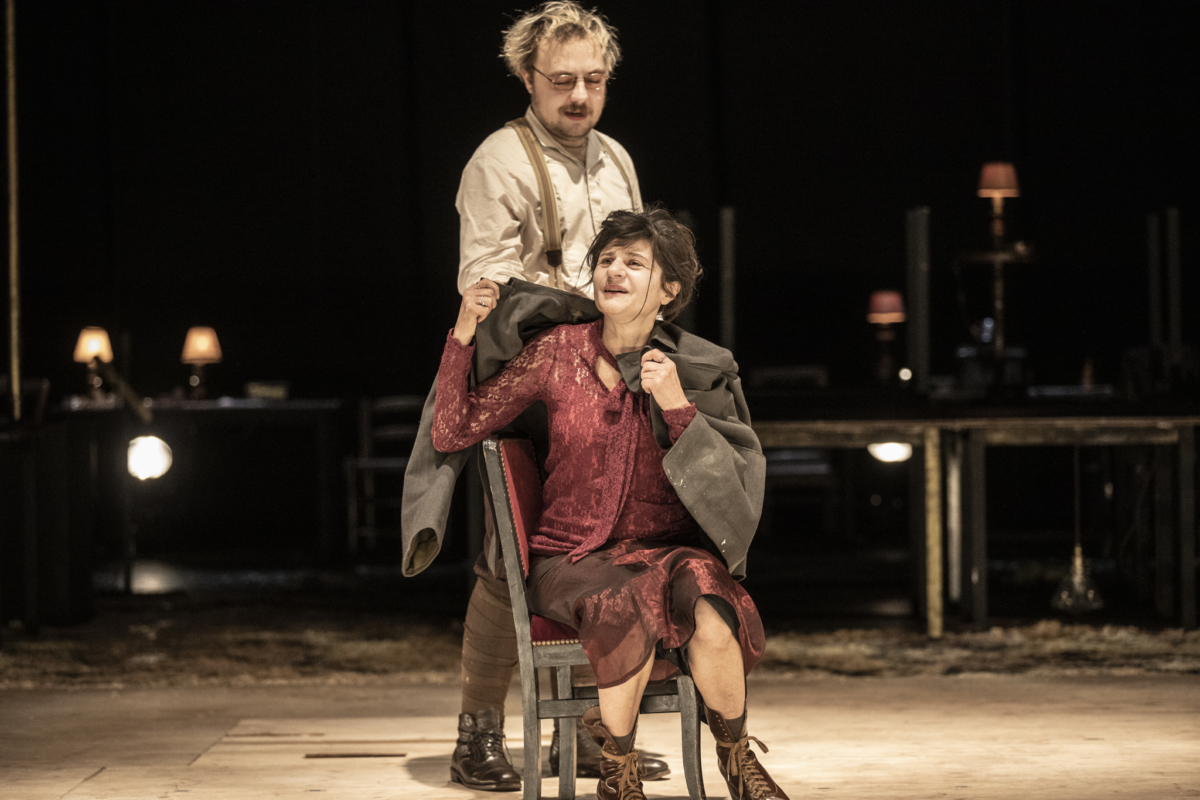
And how, pray, is the audience to guess why Ivanov’s wife Anna Petrovna is called Sarah in the course of the action, if it does not know that she is “Sarah Abramson by birth”? What we would now call the “Jewish theme” is handled by Chekhov with astonishing precision. “Anna is a wonderful, extraordinary woman... For my sake she changed her faith, left father and mother, walked away from wealth, and if I had demanded a hundred more sacrifices, she would have made them without blinking an eye. Well, and I am in no way remarkable and have sacrificed nothing. Still, that is a long story... The whole point, my dear doctor (hesitates), is that... in short, I married for passionate love and swore to love for ever, but... five years have passed, she still loves me, and I... (Shrugs his shoulders.) You tell me she will soon die, and I feel neither love nor pity, but some kind of emptiness, weariness. From the outside, I must seem dreadful, no doubt; but I myself do not understand what is happening to my soul...,” Ivanov confesses in the first act. That does not stop him, however, from calling his wife a “Yid” once all the other arguments with which he might justify his irresponsibility and cowardice have been exhausted. And a few scenes later the audience learns that there was no passionate love either: Ivanov had counted on a large dowry, but miscalculated, and he blames his wife for that as well.
The talk of the mésalliance of Ivanov, who has married a Jewish woman, together with all the other nastiness directed at Sarah/Anna by the “society” gathered in the Lebedevs’ drawing room, wearing clown caps, is a demonstration of everyday antisemitism, whose persistence has proved remarkably durable. And the way the hanger-on Count Shabelsky, played by Christian Esnay, mocks the unfortunate woman dying of tuberculosis is positively masterly: the hard-left French politician Jean-Luc Mélenchon could learn a thing or two from him. After her death, this same man weeps, lamenting: “I just looked at that violoncello and remembered the little Jewess... A wonderful, splendid woman!”
Indeed, both in tsarist Russia and during the Soviet period, Jews had to renounce their faith and change their names for the sake of study or work. In this case, for the sake of love. Yet Chekhov does not portray Sarah/Anna as an angel either: he had no fondness for self-sacrifice, even though through Doctor Lvov he declares that she is dying not so much of consumption as of her husband’s behaviour, of his indifference to her. In the play this heroine does not, of course, tell “Jewish jokes” or sing Tumbalalaika, one of the most popular Yiddish songs in Eastern Europe; that has been added by the director. The song does, however, fit the context:
A young man lies awake all night,
Wondering if he has chosen the right girl for his wife.
One can fall in love and make a mistake...
Ah, if only one could know the whole truth in advance!
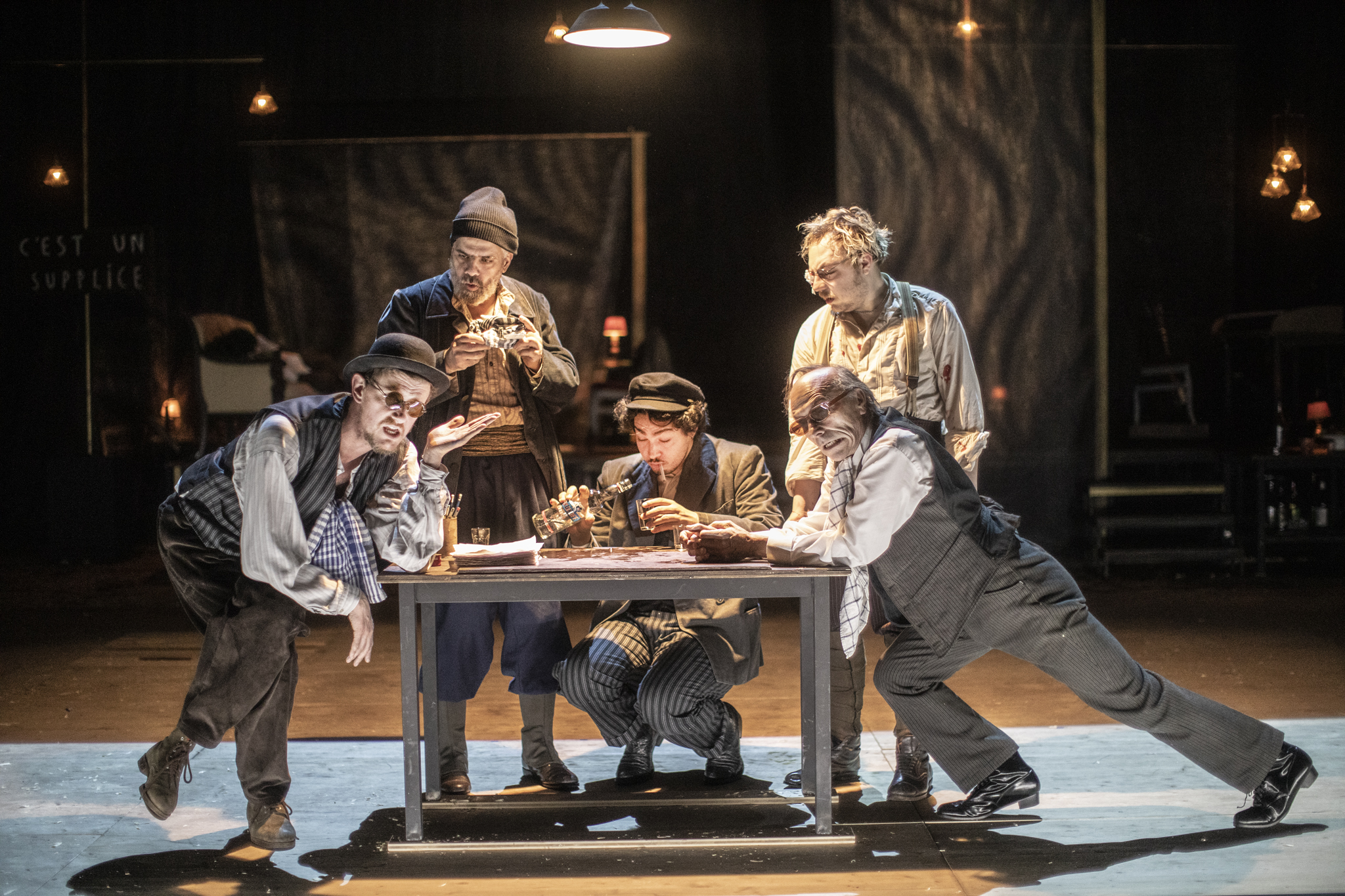
I liked the young actor Yanis Boufferrache in the role of Kosykh, an excise official. Let me explain that in the nineteenth century an excise official was a civil servant responsible for collecting taxes on alcohol, which matters in the context of Ivanov. What I do not understand is why the card-playing theme in his unceasing verbal outpouring was replaced by a musical one. Was it only to inform the audience of the fondness for drink of Brahms, Liszt, Tchaikovsky and Stravinsky, and thus somehow bring geniuses closer to the characters and, along with them, to the image of the average Russian? In the play, everyone drinks, and drinks a great deal. A national trait.
...All the conversations are about money, all the monologues about their own worthlessness, and the overall feeling is boredom. Ivanov’s self-flagellation, “I am guilty, guilty”, is an answer to the first eternal Russian question, “Who is to blame?”, posed in the 1840s by Alexander Herzen and usually paired with the second, written on a sheet of plywood placed on stage in front of the actor: “What is to be done?”
Chekhov’s answer, from this connoisseur of human souls, is unambiguous: everyone is guilty, precisely because no one does anything.
A comedy should be funny. This one was not. Like the characters, I was bored for the full two hours and forty minutes. No intermission – no escape. A Chekhovian dead end, but without the essential thing, without Chekhov’s playing on our nerves.