
To Novosibirsk, to Novosibirsk!

It so happened that over the past couple of months I have plunged headlong into the work of the 35-year-old Russian director Timofey Kulyabin, towards whom I had previously – and now it can be admitted – felt a certain wariness: the scandalous story with Tannhäuser had indeed left that notorious taint. But it began to dissipate after my first meeting with Timofey in Zurich, after the enthusiasm of our respected correspondent for his production of Nora there, and then, already in December in Moscow, after seeing the magnificent Ivanov at the Theatre of Nations in Moscow and the no less magnificent Don Pasquale at the Bolshoi, it disappeared completely. So I was awaiting the arrival of Three Sisters in Geneva with a certain impatience. But also with some apprehension, mindful of recent experience.
And so last Thursday I set off for the first performance at the Théâtre du Loup, pleased to meet in the theatre several of our readers who had responded to the publication of the interview with Timofey Kulyabin. It should be noted, by the way, that in that interview the director told the plain truth – both about the classical nature of the production, and about the new demands placed on the actors, and about the greatness of the text.
Friends, I will spare you a retelling of Three Sisters and will go straight to the point.
In short the main thing that I liked about this production is the director’s unquestionable fidelity to Chekhov: both in form and in content. The announcement “Three Sisters by Anton Chekhov”, without any “based on”, corresponds to reality. This is Chekhov – plain and simple.
I will begin with the form, it is simpler. Anton Pavlovich, as is well known, clearly defined the genres of his works and, having recorded Three Sisters as a drama, knew what he was doing. Drama as a genre, as we remember from the university curriculum, became particularly widespread in the literature of the eighteenth to the twenty-first centuries, gradually displacing tragedy and “replacing” heroics with everyday plots and a style of narration – or rather, of dialogue – closer to daily life. Such a development can be considered logical, since tragedy is rather an exceptional phenomenon, whereas there are dramas in almost every family. In Three Sisters there are as many dramas of varying depth as there are characters – fourteen: all of them are unhappy in their own way, and each of these human dramas Timofey Kulyabin conveys to the audience. It may seem that Natalia is an exception, but is that really so: is it much of a joy to live with one man and have children by another?! (Anticipating the comment of a meticulous reader, I will add: yes, for Anfisa – the only one! – everything ends well, but she too had her own drama: the fear of being turned out into the street.)
Chekhov conceived his work as a play in four acts, apparently not without reason either. But I cannot recall a recent production that would take this authorial instruction into account: it is rare to see four acts reduced to three, more often to two, or even performed without an interval at all. But that is when it is “based on”. Naturally, we live in a fast-paced age, everyone is in a hurry, no one wants to lose the audience, and who will sit through four and a half hours? And I am not complaining, merely emphasising that Timofey Kulyabin took this risk and did not misjudge it: for all these four and a half hours (the four acts are divided by three 12-minute intervals) the audience alternately held its breath, freezing with empathy for the characters, and reacted vividly – laughing and crying. A lady sitting behind us even snorted with delight. But seriously, finding ourselves seated between a respectable elderly couple and an eighteen-year-old young man, we could not help but observe, with satisfaction, that they reacted in exactly the same way.
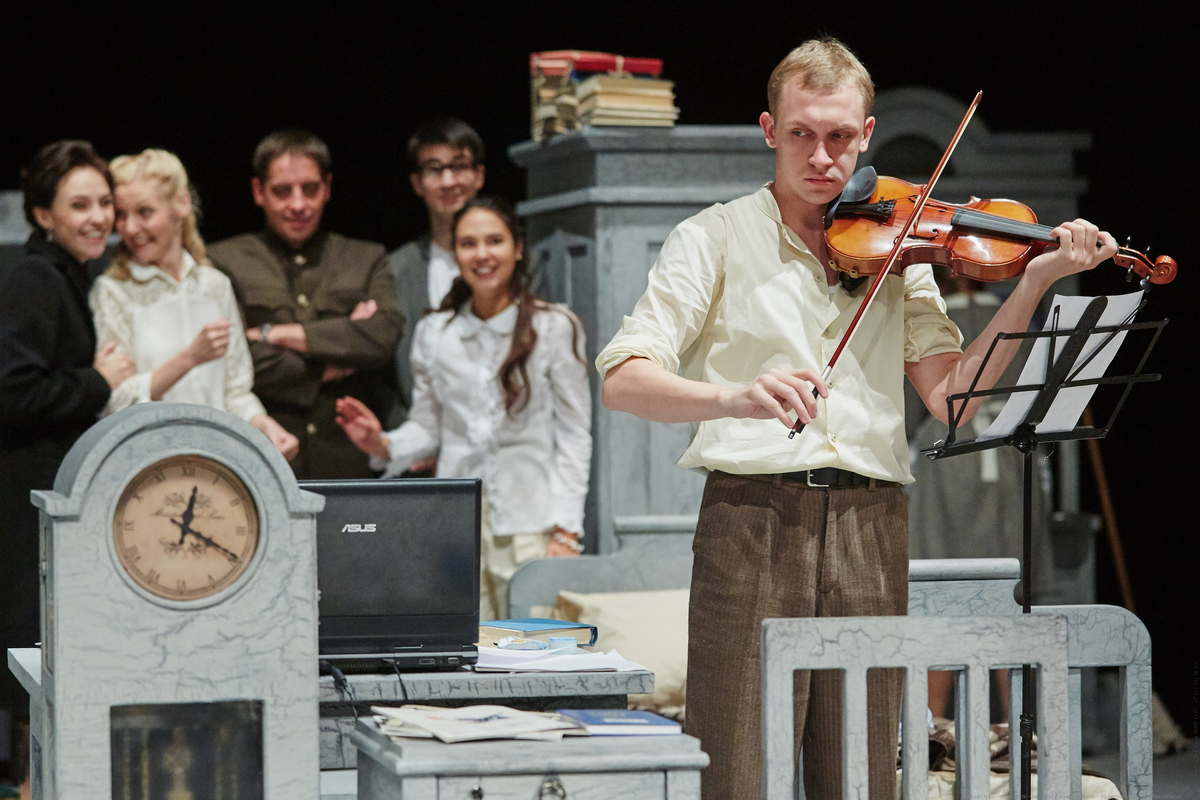
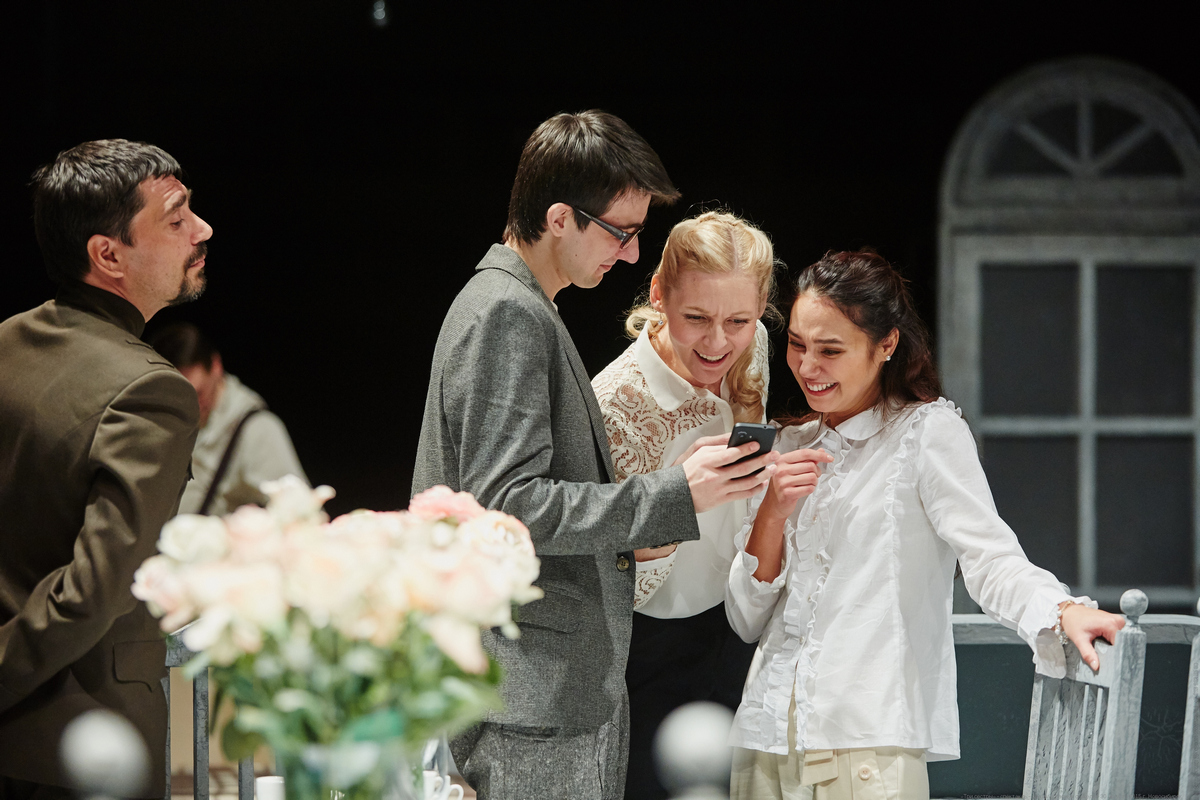
In the superimposition of contemporary means of communication onto a classical text and the traditions of classical theatre, in the construction of new relationships “spectator – theatre”, “spectator – text”, “spectator – performance” lies the undeniable innovation of the production, in which the time of the action cannot be immediately determined – but does it matter? Yes, iPhones coexist on stage with a samovar, and Fedotik loves taking selfies in which Chebutykin, in his long-obsolete long johns, does not wish to appear. So what? After all, Chekhov’s sisters in Kulyabin’s interpretation have not turned into bank clerks sitting at computers. It is quite clear that for the director the factor of time is not of great importance, whereas new types of relationships are – their essence, like the essence of people themselves, does not change, guaranteeing Chekhov’s masterpiece eternal life.
Another great merit of the director, in my view, is that by depriving the actors of speech he compels the audience to read the text, from beginning to end: the action is accompanied by the full versions of Three Sisters in French and English, without cuts. (Note that on 23 January the English surtitles will be replaced by Russian ones – not everyone, after all, knows the play by heart!) I am sure that everyone found something of their own in the text; what caught my eye was Veshinin’s remark to Masha, which I had previously overlooked: “The Russian is to a high degree endowed with an elevated turn of mind, but tell me, why in life does he grasp so low?” Masha gives no answer, merely responds to a question with a question.
In the absence of spoken monologues and dialogues, numerous sounds, which usually content themselves with the role of background, come to the fore in the performance. We listen attentively to the whistle of the samovar and start at Masha’s piercing whistle, sharing Irina’s indignation at the latter. We react to the ticking of the old clock and to the shuffling – incredibly expressive! – of Anfisa’s slippers; we wince at the false sounds of Andrei’s violin and at Chebutykin’s drunken mumbling. A chill grips the stomach at the alarm bell announcing the fire, and at the funeral toll.
For whom does Chekhov’s bell toll? For lives wasted in meaningless waiting, for unrealised dreams, for shattered illusions, for love not met or not returned. There was hardly a single person in the auditorium whose heart did not respond to the strokes of that bell. The sound and lighting design of the performance play a central role, carefully leading the audience from something close to comedy in the first act to a drama bordering on tragedy in the finale.
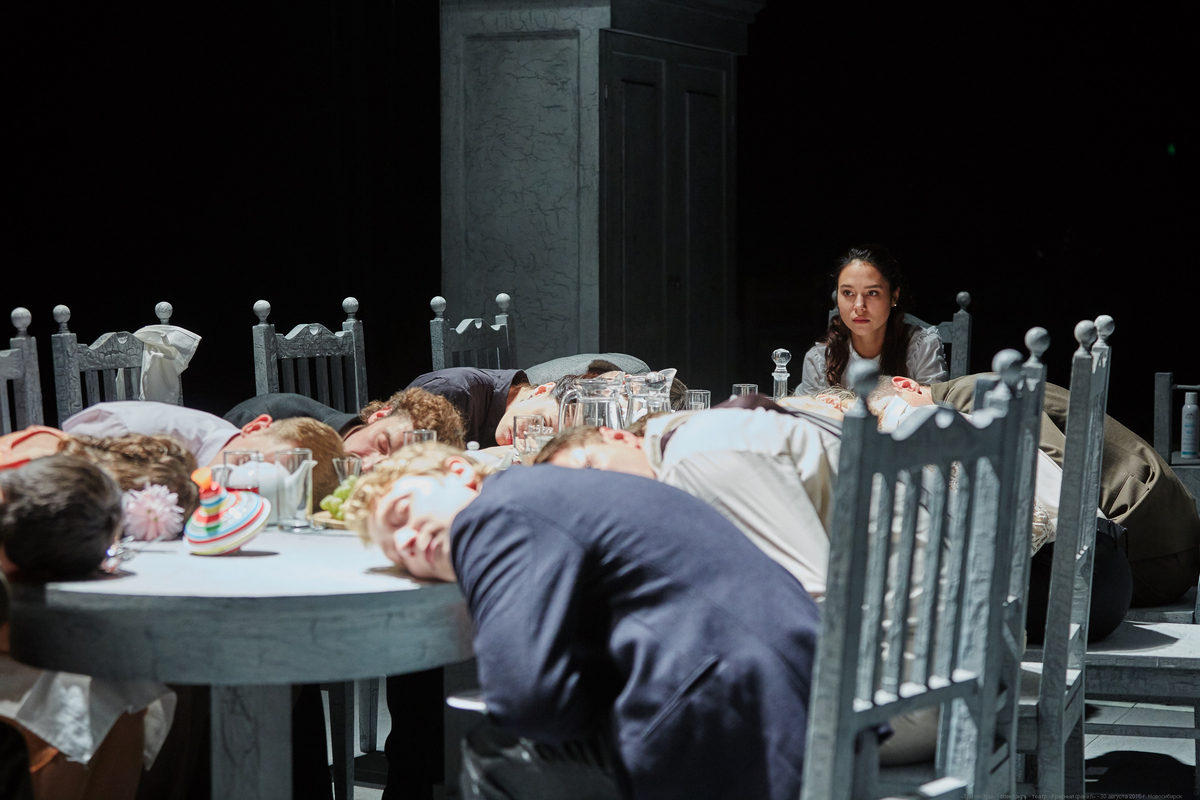
The performers deserve separate and the highest praise – the entire cast as a whole and each actor individually, and not only for having mastered sign language. Timofey Kulyabin was right: of course, it is much more difficult for them to act without words, without text behind which one can hide. But what new reserves are revealed, what means of expression! No words can replace the look full of hatred and contempt that Masha casts at Kulygin, asleep at the table with his mouth open, or the infinite melancholy in the gaze of Fedotik as he parts with Irina forever. And it seems entirely natural that Irina, unwilling to hear Solyony’s declarations, does not cover her ears but covers her eyes with her hands. And in my head there kept turning Andrei Voznesensky’s very everyday poem “The Cashier”, with this line “Oh, the smell of these tears in the lowing crowd”.
Сuriously, when Ferapont appears on stage and suddenly begins to speak to Andrei in a human, so to speak, voice, it sounds like a complete dissonance, so much have we, the spectators, already adapted to a different manner of interaction. But here too Kulyabin is faithful to Chekhov. Having returned home after midnight, I took down from the shelf volume 9 of the Collected Works and check against the original. Everything is correct, here is the passage:
“Ferapont: I cannot say… I hear poorly…
Andrei: If you could hear properly, then perhaps I would not speak to you.”
And it does not matter that in the production Andrei does not speak at all; what matters is that before us is a dialogue of the deaf, into which all the characters are drawn, desperately trying to shout to one another and not hearing each other at all!
Those who have eyes, let them hear! This is my advice to all those who have not yet seen this wonderful production, tickets for which can be purchased here.