
What do you know about Simone Weil?
In Geneva, there are places that are very difficult to describe – you really have to see them for yourself. One such place is the Pavillon SICLI, presented on its website as follows: “Designed and realised by the architect Constantin Hilberer and the engineer Heinz Isler between 1966 and 1970, the former SICLI factory – now the Pavillon SICLI – is recognised as a building of significancefor twentieth-century architecture in Geneva and Switzerland. A key building of the Praille-Acacias industrial district, the building was constructed to house the administration, logistics and production of SICLI SA (Secours Immédiat Contre L’Incendie), a company specialising in the manufacture and distribution of firefighting equipment. It consists of two volumes of different sizes united under a single asymmetrical shell supported at seven points. Remarkably slender, this prestressed concrete shell of free form makes the Geneva building one of the most original and technically sophisticated works of the renowned Swiss engineer.”
But how can one explain, in simple terms, this asymmetrical shell and the seven points on which it rests?! It is reassuring that it will, it seems, rest there forever: in 2011 the company Sicli moved out, and the State of Geneva acquired the building in order to create a cultural centre dedicated to architecture, urban planning and design, and in 2012 it was entered in the cantonal register of historical monuments and has since been protected from demolition.
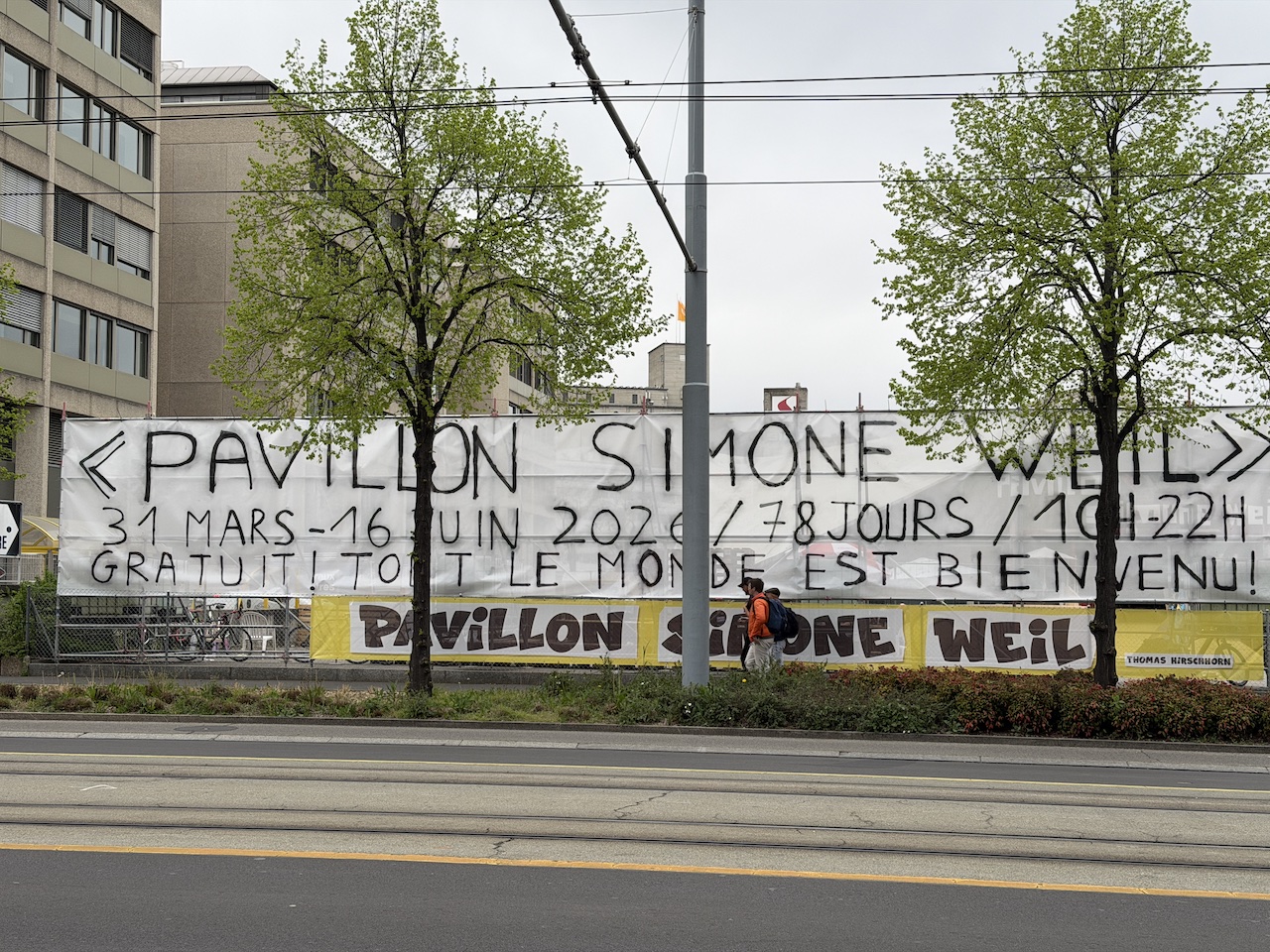
I had passed this building countless times without ever wondering what was inside. But recently, finding myself nearby again, I noticed a new banner on the façade: “Pavillon Simone Weil”. I thought at once of that Simone Veil who survived Drancy, Auschwitz and Bergen-Belsen and became a major political figure in France and Europe, and I was even struck by how little this banner corresponded to her always austere and elegant image. But I decided to go in.
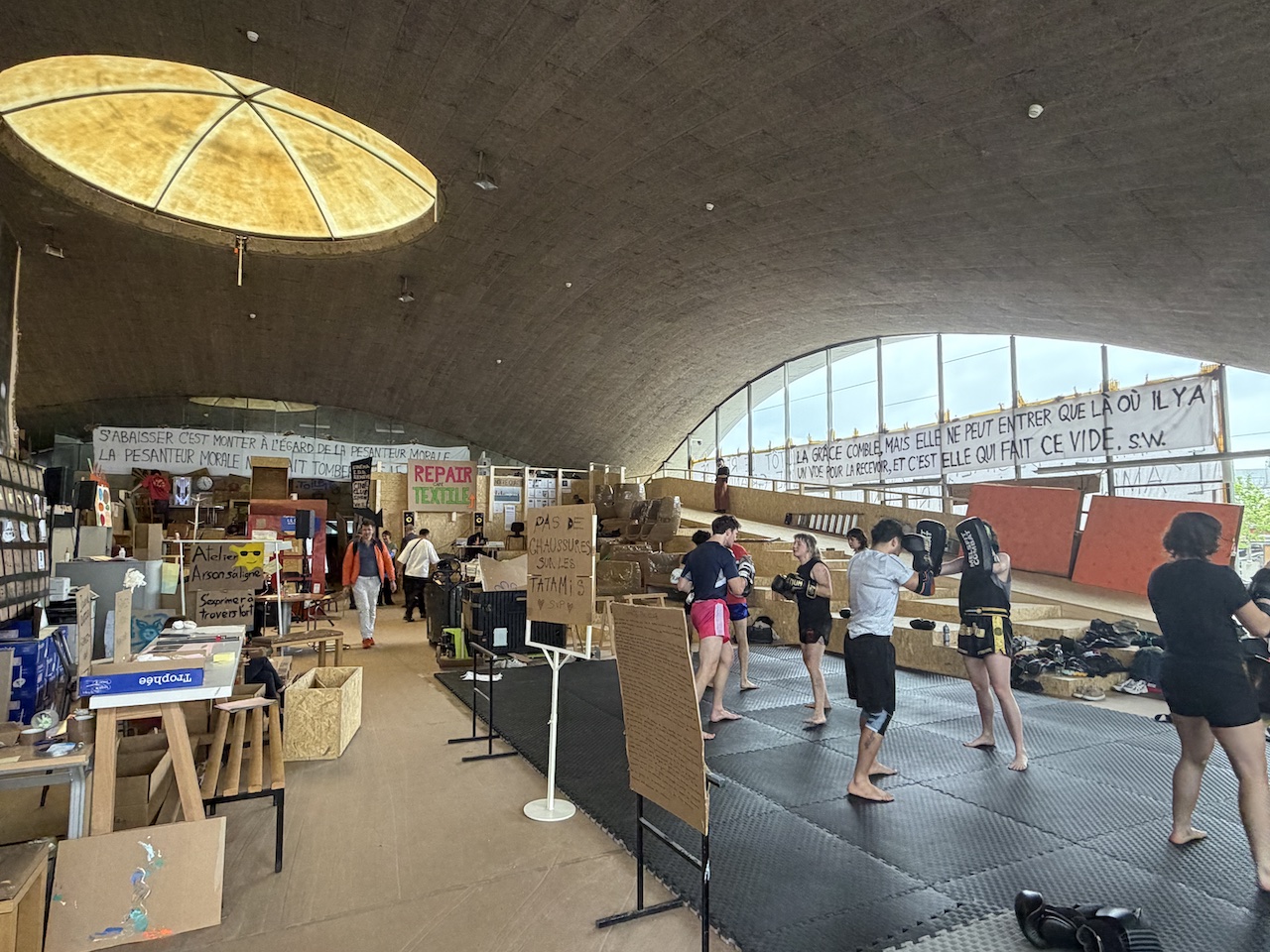
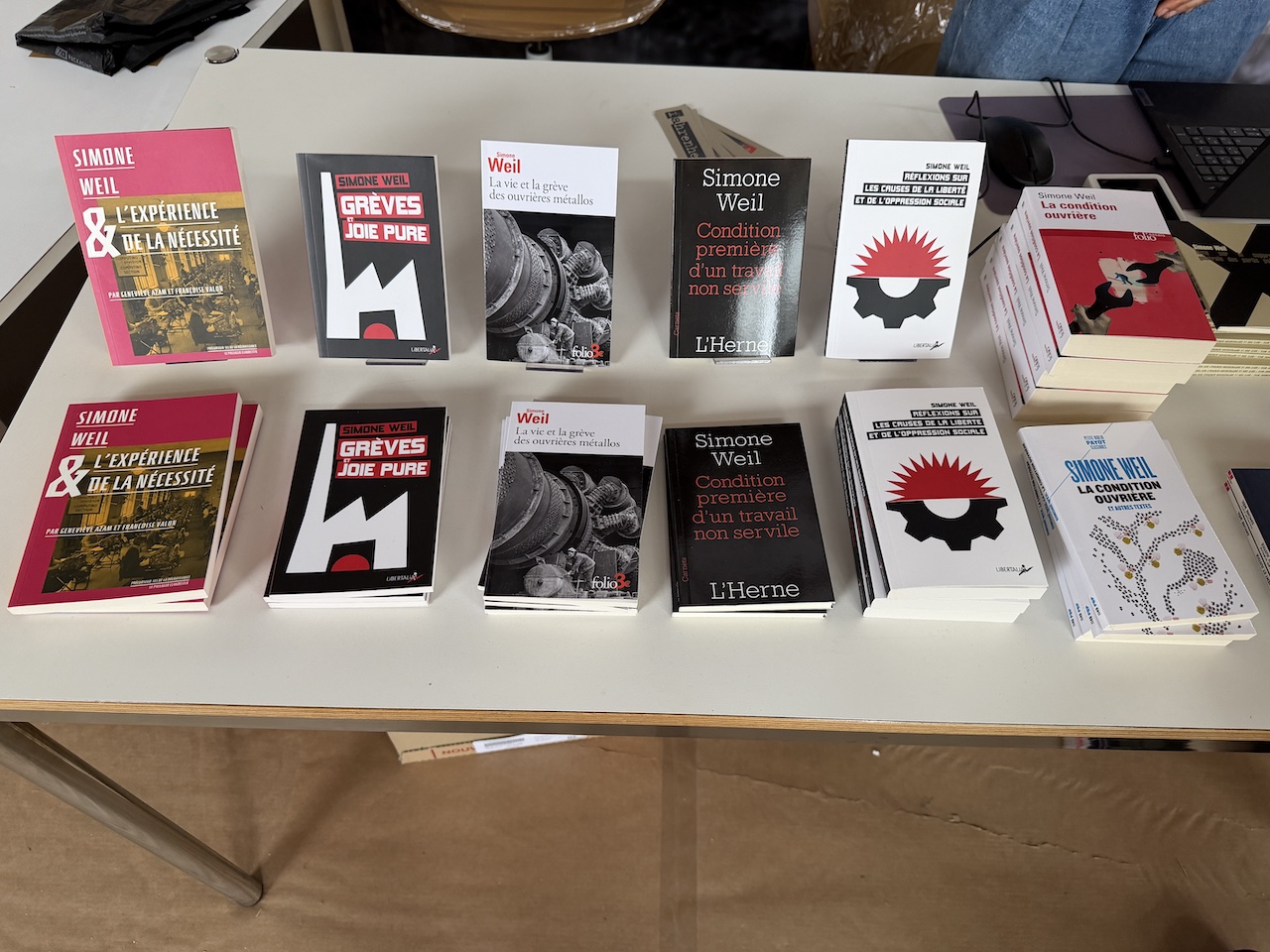
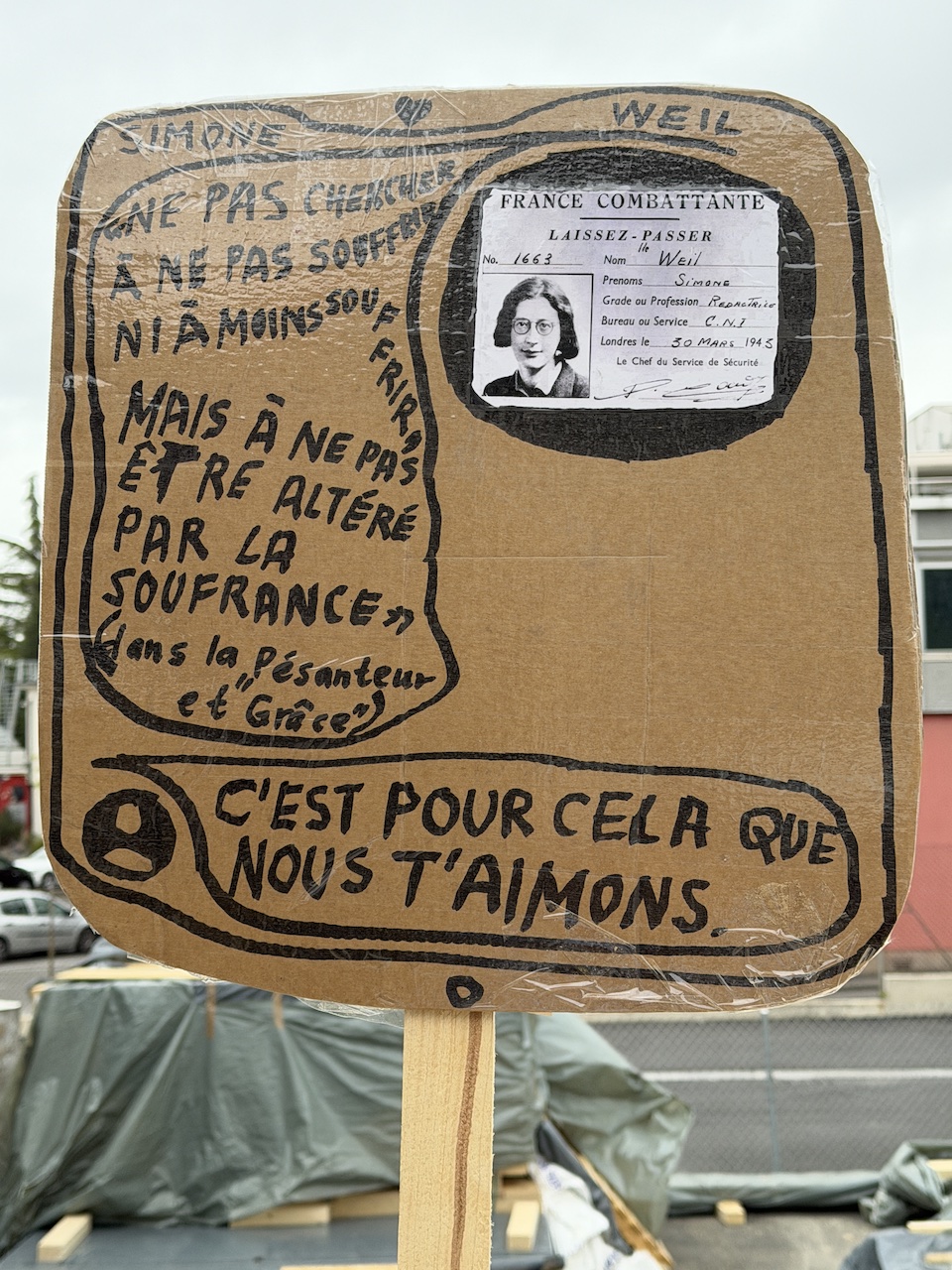
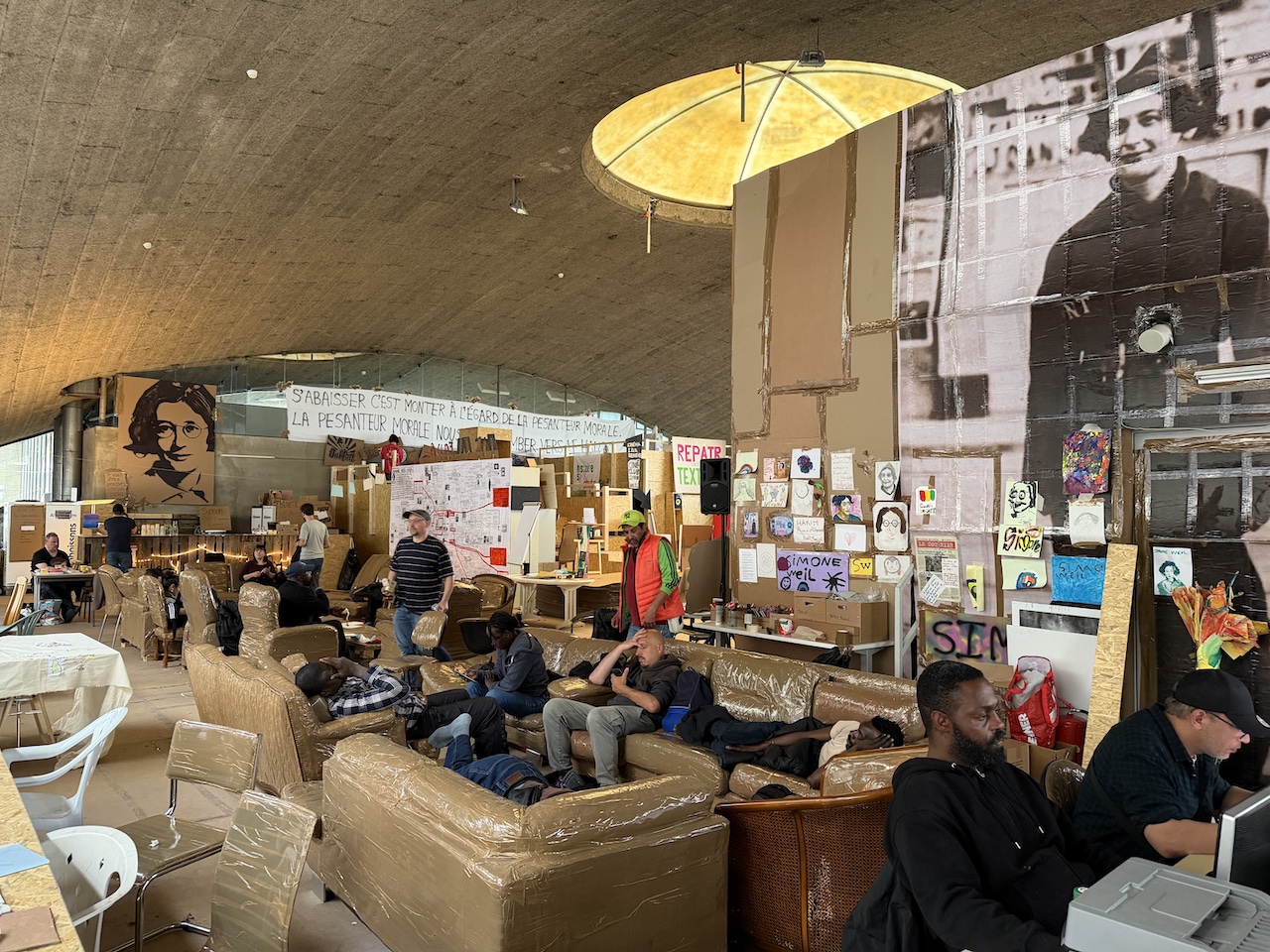
I admit I hesitated on the threshold, so striking was what I saw. In this vast space, which resembled a hangar more than an exhibition venue, a boxing training session was underway to the right of the entrance, while to the left people were gathered around a table piled with books – on the covers of numerous editions appeared one and the same name: Simone Weil. So that was it! Not Veil, but Weil, that is, an entirely different Simone, of whom, I admit, I had never heard, although her “Russian accent”, as I discovered, is unmistakable. Her face, reproduced in large format, was looking at me from all the walls and specially installed panels: a typical face of an intellectual of the early twentieth century – short hair, glasses, intelligent eyes, a sincere smile…
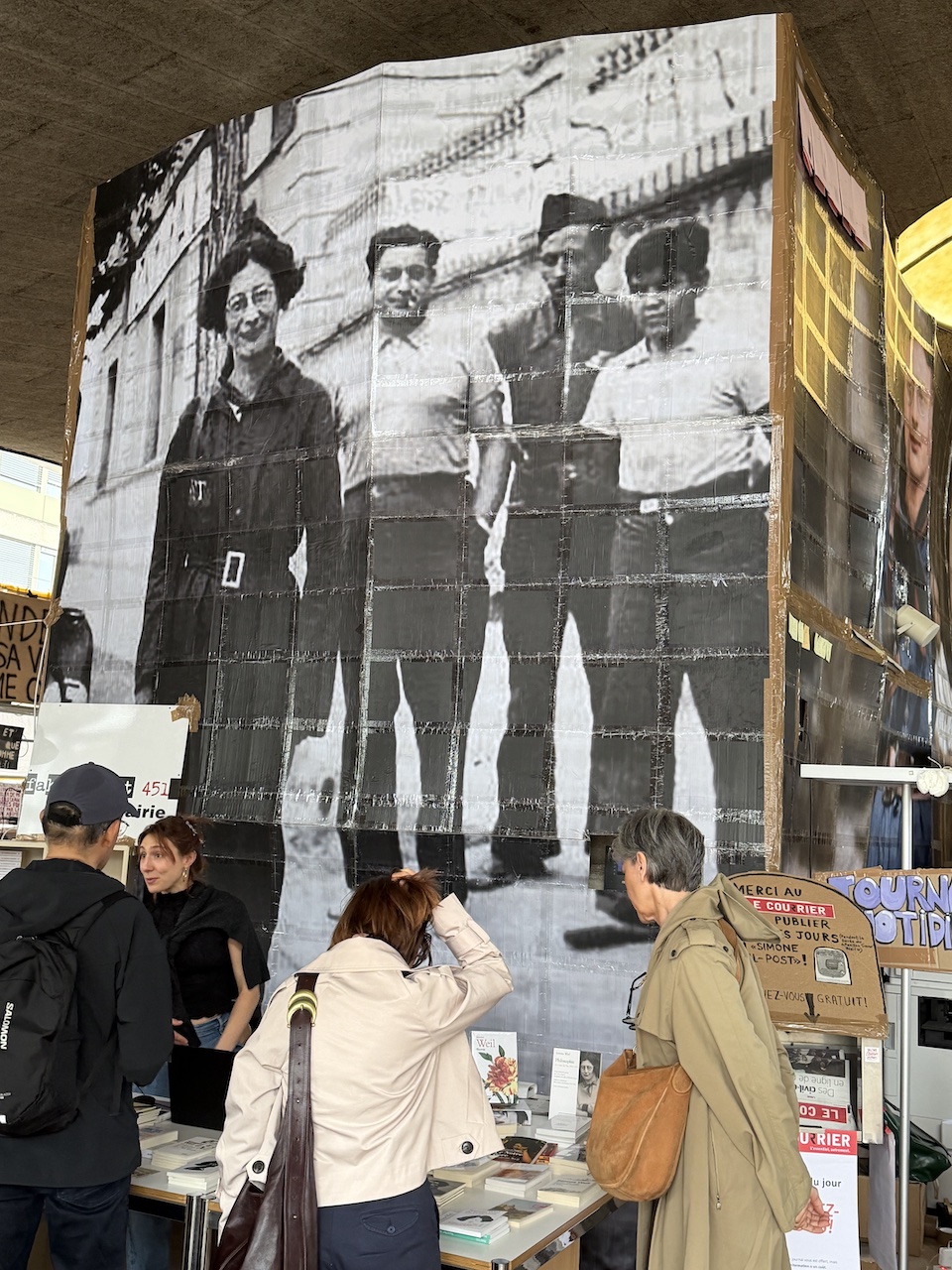
It is in this way that the Swiss artist Thomas Hirschhorn, known for his collective and interactive creations – one may recall the giant sculpture of the writer Robert Walser installed in Biel in 2019 – has chosen to pay tribute to Simone Weil, who attracted him by her “radicality and singularity”, as well as by her theory of attention and her reflections on grace.
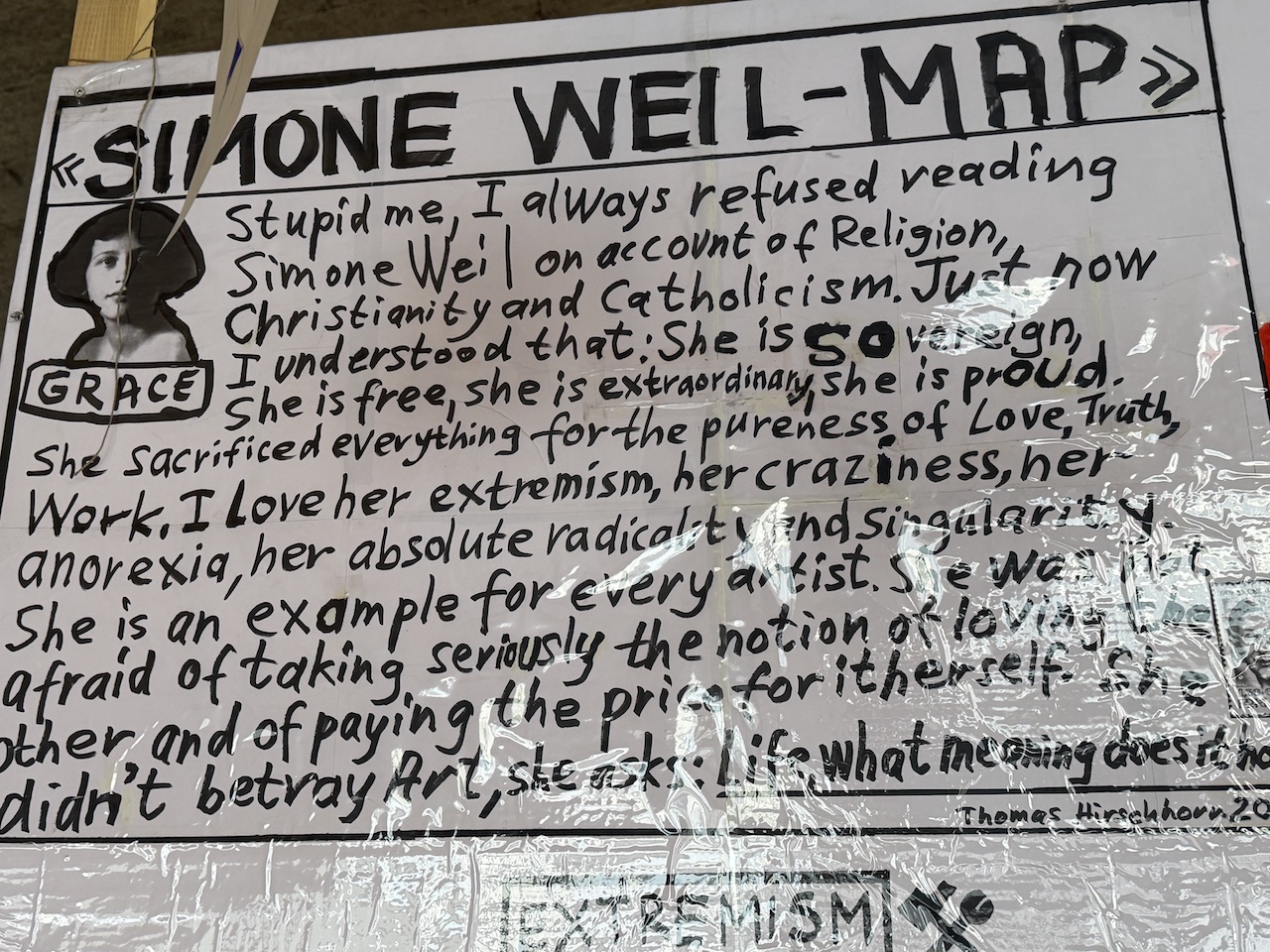
Next to the “map of Simone Weil’s life”, drawn by Thomas Hirschhorn, there is an explanation of the project by the artist himself, which every visitor would do well to read. Here is the text: “Stupid me, I always refused reading Simone Weil on account of Religion, Christianity and Catholicism. Just now I understood that: She is sovereign, she is free, she is extraordinary, she is proud. She sacrificed everything for the pureness of Love, Truth, Work. I love her extremism, her craziness, her anorexia, her absolute radicality and singularity. She is an example for every artist. She was not afraid of taking seriously the notion of love of the other and of paying the price for it herself. She didn’t betray Art, she didn’t lie. What moving destiny.”
Having walked through the entire installation – probably the most accurate term for what Thomas Hirschhorn has created – and having noted both young people sitting in front of computer screens and others, less young, settled on sofas strangely covered in plastic, I returned home and immediately went online to find out more.
The Wikipedia pages devoted to Simone Weil, a French religious thinker and philosopher, exist in 65 (!) languages. They vary in length, but in the most concise form the short life – only 34 years – of this unquestionably extraordinary woman can be described as follows.
She was born in 1909 in Paris into a family of agnostic Jews; her father, Bernard Weil, a military surgeon, came from Alsace, and her mother, Salomea Reinherz, was born in Rostov-on-Don and raised in Belgium. In her own words, Simone received no religious education: “I was brought up by my parents and my brother in complete agnosticism.” What she did receive, it seems, was an abundance of love and attention, which shaped her entire life and, to begin with, her academic success: entering the girls’ lycée in Laval in October 1917, she finished the school year with a prize for excellence. In 1928, at the age of 19, she ranked sixth out of 218 in the entrance examination to the École normale supérieure on rue d’Ulm. It was at the École normale supérieure that Simone, together with her fellow students, became involved in political activity – through petitions, collections for trade union strike funds and unemployment funds – and, after completing her studies, she taught philosophy in various schools in France.
I do not know whether the fact that Simone Weil began her formal education at the very moment when the October Revolution was taking place in Russia played a role in her life, but I am certain that this event was widely discussed in the Weil family, so that as early as 1919, at the age of ten, the girl declared herself a Bolshevik, hardly understanding what the word meant. One coincidence is striking: in that same year, 1919, the American journalist John Reed published in New York the book that fixed the image of the revolution forever as Ten Days That Shook the World, which greatly pleased Lenin.
Despite this childhood declaration and the active interest she later showed in Marxism, Trotskyism and anarchism – something typical of educated young people of her generation – Simone Weil never joined the Communist Party; however, having carefully studied the works of Karl Marx, she quickly understood how far his theory diverged from practice in the USSR. It is quite possible that her participation in the Cercle des communistes démocratiques of Boris Souvarine – born in Kyiv under the name Lifshitz, co-founder of the French Communist Party, who chose his pseudonym after a Russian revolutionary in Zola’s Germinal – led her to deeper reflection.
Before becoming a theorist, Simone Weil was a very active practitioner. In 1932 she travelled to Germany to help Marxist activists in the anti-fascist struggle, and after the Nazis came to power in 1933 she provided shelter for German left-wing émigrés fleeing the Hitler regime and helped Leon Trotsky, already declared an enemy of the revolution in Russia, to organise clandestine meetings in her father’s flat. In the mid-1930s she worked in car factories in order to better understand the aspirations of the proletariat, and in 1936 she could be found in Spain – with a journalist’s card, in a unit of anarchists fighting on the Republican side. During the Second World War Simone Weil lived in a Dominican monastery in Marseille and was involved in the Resistance, and in 1942 she fled to England, where she joined Charles de Gaulle’s Free France and prepared radio broadcasts for it, although she did not fully share his views. At the same time, in solidarity with the victims of Nazism, she reduced her food intake to the level of rations in Nazi concentration camps, which led to her premature death from heart failure complicated by tuberculosis.
It is interesting that in the late 1930s Simone Weil adopted Christianity, which she herself described as non-confessional, although it is known that her thinking was also influenced by Jewish and ancient Greek mystical traditions, as well as by Hinduism and Buddhism – perhaps because of the question that unites them: suffering, and in particular the suffering of the innocent. This, I believe, explains why the first translation of one of her texts – Gravity and Grace – appeared in Russian in 1972 not just anywhere, but in the Vestnik studencheskogo khristianskogo dvizheniya, published in Paris since 1925. In the USSR her works were not published; the first sign of change came with the publication of The Iliad, or the Poem of Force in the journal Novy Mir in 1990, with an introduction by Sergei Averintsev, the renowned philologist and historian, who in the same year became chairman of the Russian Biblical Society, and an afterword by Alexander Sukonik, who had emigrated to the West as early as 1974 and devoted much of his work to the theme of the split within Russian cultural thought, inevitably leading to tragedies. Such framing suggests that even at the end of the “Gorbachev period” Simone Weil’s texts were approached with caution; nevertheless, they clearly aroused interest – since then other of her writings have been published, and the St Petersburg publishing house Ivan Limbach has brought out her Notebooks in three volumes.
I will be honest: I have not yet read a single one of her books, most of which were published after her death, and I am only just about begin, although I am not sure that all her ideas will resonate with me. I will probably begin with Reflections on War (1933), an article by Simone Weil published in November 1933 in issue no. 10 of the journal La Critique sociale, edited by Boris Souvarine; it is now available in the French original online. Here is the opening sentence: “The present situation and the state of mind it produces once again bring the problem of war to the forefront. We are currently living in a perpetual expectation of war; the danger may be imaginary, but the sense of danger exists, and constitutes a factor that cannot be disregarded.”
But one statement, greeting visitors to the Pavillon SICLI until 16 June, has already found a response in my heart: “Attention is the rarest and purest form of generosity.” How well it is put, is it not? So, thank you for your attention to my texts, dear readers.
P.S. A few days ago, after this text had already been written, I learned that incidents had occurred in connection with Thomas Hirschhorn’s project at the Pavillon Sicli in Geneva. According to Le Temps, they were linked to alcohol distributed free of charge on the site. The artist acknowledges a mistake, but also points to the issue of precarity within the Geneva population, made more visible by this project. Yet another sad ending to intentions that, I have no doubt, were good.