
Vasyl Stus Rediscovered by Georges Nivat: The Story of One Palimpsest
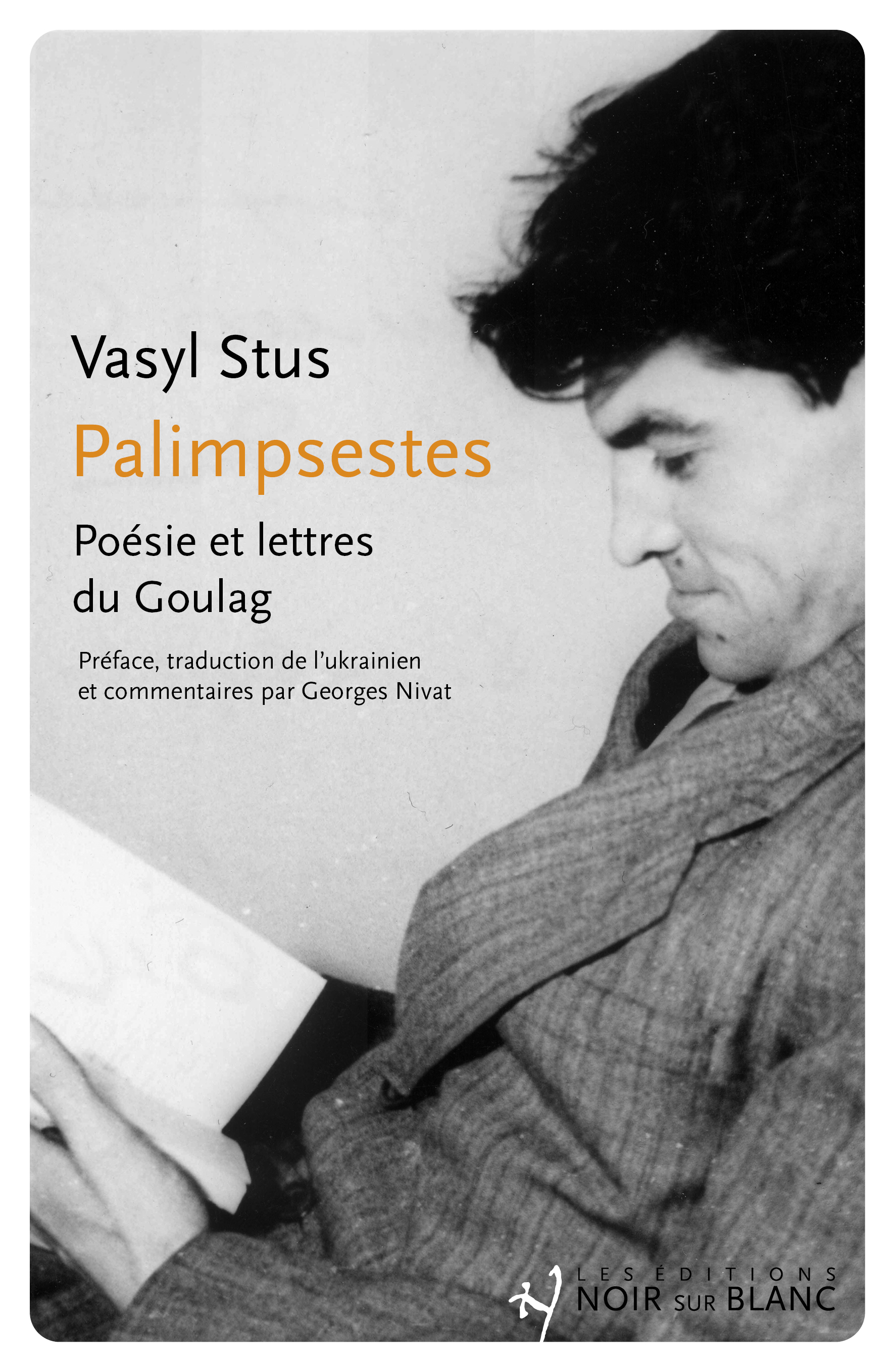
Last year, 2025, was doubly commemorative for Georges Nivat, honorary professor at the University of Geneva: 90 years since his own birth and 40 years since the death of Vasyl Stus, the Ukrainian poet and dissident whose work and fate have occupied the thoughts of the eminent Slavist in recent years. Professor Nivat set himself the goal of restoring justice and introducing the French-speaking public to the work of a man whom he considers the second national poet of Ukraine after Taras Shevchenko and whom he compares, in terms of poetic gift, with Paul Celan and Osip Mandelstam.
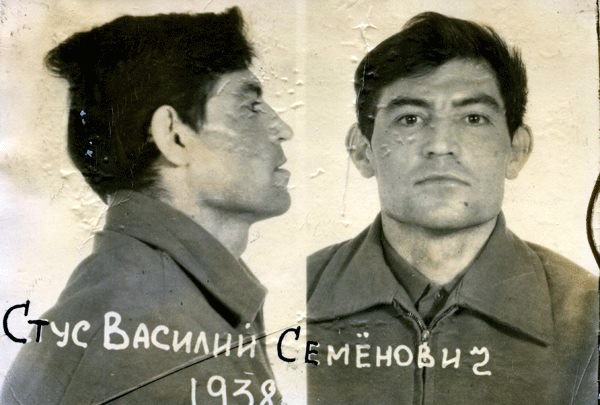
Although Professor Nivat became seriously interested in the Ukrainian language and literature six years ago, it was the war in Ukraine that, of course, influenced this decision. “Stus was a young poet from the Donbas, an avant-gardist, a follower of the tradition of the ‘Executed Renaissance’ of the 1920s. Some of them were shot in Sandarmokh, some committed suicide, a handful submitted and became Stalin’s favourites. Stus was born in 1938 and died as a result of a hunger strike in a camp in 1985. It was precisely in Kolyma that he understood that ‘life is a vanishing moment’. His stay in the hell of Kolyma turned him into a European poet. Like Byron, Lermontov, Celan and Mandelstam, he belongs among the ‘burnt’ poets. Working on translations of Stus helped me to survive today’s catastrophe, giving me the opportunity to help Ukraine to the best of my ability,” he said clearly when speaking at the Russian Circle of the University of Geneva at the end of last year.
This “best of his ability” turned out to be a 600-page volume ending with the following words by Georges Nivat: “Vasyl, you were born four years after me and died half a century ago. And I am still here to listen to you and to try to make the tragic sound of your verses resonate in the language of Agrippa d’Aubigné, the universality of your poetry in the language of Hugo, the infernal, grotesque and divine element of your Palimpsests in the language of Rimbaud. Your prophetic voice immerses me in a volcano that no one will see extinguished, for your voice comes from the eternal present of poets. But above all, your voice, which seems to come directly from beyond the grave, causes in me a shudder I have never felt before. You are the voice and the call of a country that is tormented yet mysteriously blessed. May your words heal Europe and pass from generation to generation! May this blessed country once again become the new Hellas that it once was!”
(I can already anticipate the remark of vigilant readers: not half a century, but forty years. Of course, Georges Nivat knows this perfectly well, but as he told me with his characteristic humour, at his age ten years more or ten years less make little difference – one may round the figure. What truly matters, however, is the passionate spirit of this author whose soul remains young. May God grant him health!)
Mea culpa! Knowing quite well the work of Taras Shevchenko, which we studied at Soviet school, and having a very clear idea of his appearance thanks to the monument erected in the centre of Moscow – the monument which, incidentally, still stands not far from the embankment bearing the poet’s name – I had only vaguely heard of Vasyl Stus until Georges Nivat began to speak about him with increasing insistence. What can I say in my defence?
Vasyl Stus was an “anti-Soviet”. In 1972 he was sentenced to five years in labour camps in Mordovia plus two years of exile in Magadan. For what? The pretext was an incident at the Kyiv premiere of Sergei Parajanov’s film Shadows of Forgotten Ancestors, when Stus called on the audience to stand up in protest against the arrests of Ukrainian cultural figures. He was also accused of publicly charging Ukrainian KGB officers with the murder of the artist and dissident Alla Horska in 1970. After a short period of freedom he received a new sentence in 1980: ten years in labour camps and five years of exile. The guards watched him zealously. The journalist Andrei Filimonov recounted that in August 1985 Stus was placed in the punishment cell of the Perm-36 camp for allegedly leaning his elbow on the bunk while reading a book. In protest Stus declared a dry hunger strike and died a week later, according to the official version from heart failure, although there is also a version that he was beaten to death by the guards.
As you understand, with such a biography there could be no question of official publications –as far as I know, none of the poet’s collections, written in Ukrainian, has been published in Russian in an academic edition. However, I found quite a few translations of his poetry on the internet, and some of them appeared while Vasyl Stus was still alive. Among those who worked on them were, for example, Alexandrina Kruglenko from Donetsk and the human rights activist Elena Sannikova, who herself had gone through Siberian exile – a collection of her translations appeared in 1994 in the series Poets – Prisoners of the Gulag, and later a volume of translations by Marlena Rakhlin was published in Kharkiv. Yet he still remains unknown to the broad Russian-speaking readership, and I hope that, as Ostap Bender, the hero of The Twelve Chairs, used to say, “the West will help us”, and that Georges Nivat’s book will draw attention to Vasyl Stus both in Russia and in the diaspora.
In this context the title Georges Nivat gave his work, Palimpsests, proves remarkably apt. It contains not only an echo of the collection of the same name by Vasyl Stus, which includes poems written between 1971 and 1977, but also a deep philosophical meaning, since a palimpsest is an ancient manuscript written on parchment from which an earlier text has been scraped or washed off in order to use it again. And just as modern technologies allow us to read the hidden lower layers of writing, so Georges Nivat reveals to today’s reader an author who for decades remained “hidden” from him. It is perfectly clear that for the esteemed professor this book is not simply “another one”, but the fulfilment of a mission he set himself.
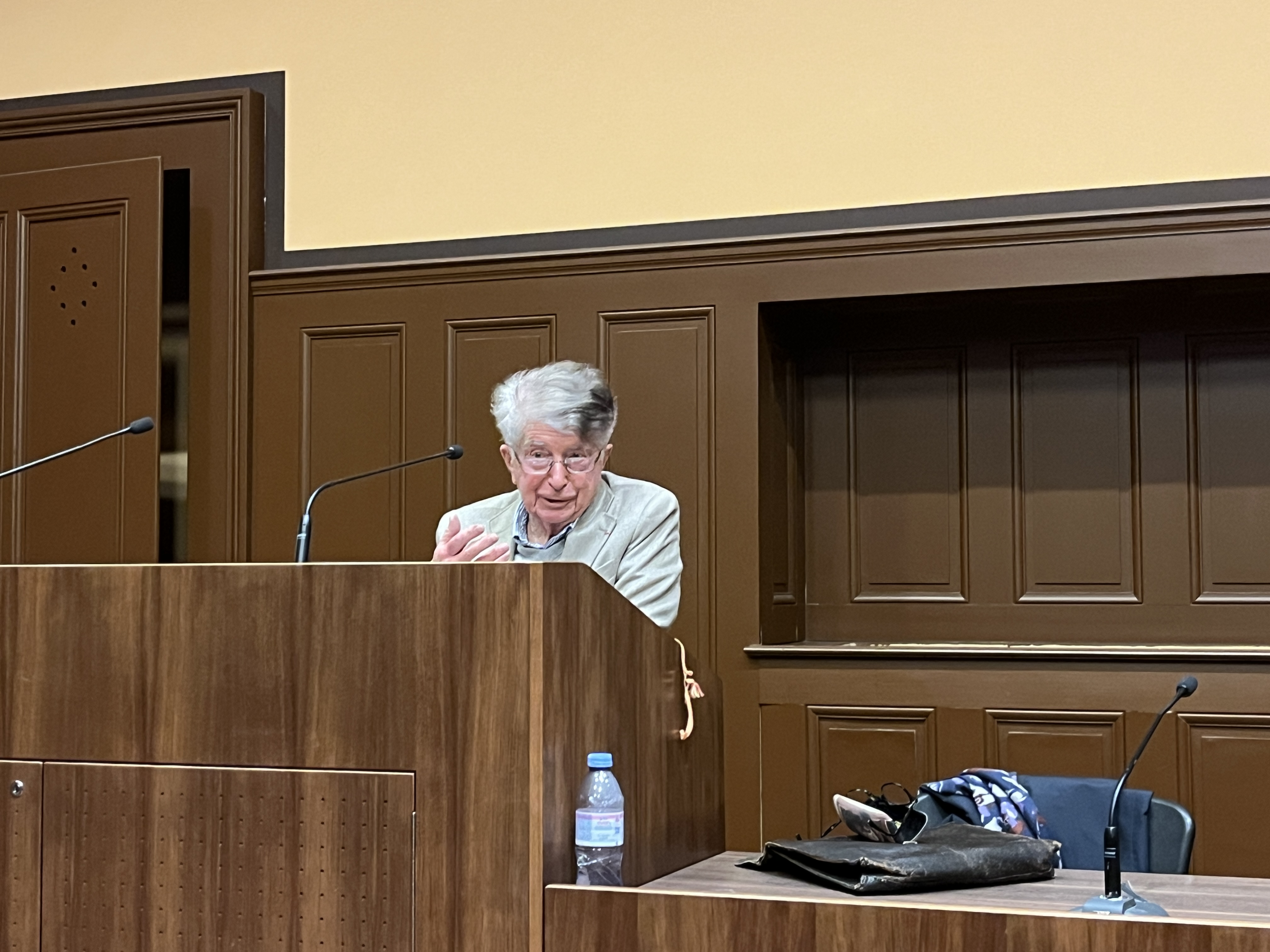
The book consists of an introduction by Georges Nivat, nearly four hundred poems translated by him and accompagnied by his commentaries, the miraculously preserved and utterly extraordinary Camp Notebook of Vasyl Stus, which begins with the words “And so on 5 March I arrived in Kolyma” – precisely on 5 March, the anniversary of Stalin’s death! – as well as several of his letters to relatives and friends. I must confess that, reading on the cover that “Stus embodies the resistance of the Ukrainian language and culture to Russian oppression”, I was preparing myself for something nationalistically militant. But I was mistaken. All these various texts create a clear image of a man who loved Ukraine with all his soul and sacrificed for its independence and prosperity first his freedom and then his life. At the same time, Stus’s nationalism has nothing in common with the primitive and repellent meaning so often attached to that word these days.
While in a Soviet camp on Russian territory and realising, I think, the hopelessness of his situation, Vasyl Stus studied English, translated Rilke, reflected on Hermann Hesse, Dostoevsky, Lermontov, Pasternak, Mandelstam and Tsvetaeva, and wrote that Mayakovsky was not guilty of the fact that Stalin loved him. Moreover, in one of the poems that impressed me most the refrain repeats: “I forgive you, furious executioners” («Прощаю вас, лихi кати моï»). Such demonstration of indulgence requires unquestionable moral superiority.
A surprising and wonderful discovery for me was the lyric poetry of Vasyl Stus – both openly love-erotic (for example the poem “Tell me, was Modigliani an idiot?” («А скажи - Модiльянi був iдiот?») and, if one may say so, “landscape” poetry: many poems contain magnificent descriptions of the harsh northern nature. I believe that, thanks to Georges Nivat, the word merzlota, left untranslated, will enter the international lexicon: it denotes the permanently frozen ground of Kolyma, hard as stone, which prisoners of the Gulag camps were forced to dig by hand. And for some readers, surely, “the merzlota of compressed souls” will strike the heart – one of the poems begins with these words.
Vasyl Stus repeatedly turns to God in his poetry. Yet on the occasion of the 1500th anniversary of Kyiv he reflects on Christianity in Ukraine and declares that he does not love it. Here is the passage which seems to me important for understanding the history and the present of this country: “I reflect on the millennium of Christianity in Ukraine. I think the first mistake was the Byzantine-Moscow rite that tied us – we who are the easternmost edge of the West – to the East. Our Western individualistic spirit, stifled by the despotism of Byzantine Orthodoxy, could not free itself from this duality of spirit – a duality that later produced in us a complex of hypocrisy. It seems that the archaic spirit of Orthodoxy lay like a rock upon the still immature spirit of the people and led us to a kind of spiritual feminisation that became our principal attribute. The Russian spirit, by contrast, was fertilised by the iron discipline of the Tatar-Mongol domination, which gave it aggressiveness and a taste for pyramids. The Ukrainian spirit did not manage to free itself from the weight of this rock of retrograde faith. Perhaps this is one of the reasons for our national tragedy. I do not love Christianity. No!”
His conclusions about the Soviet intelligentsia are also very interesting, as is the question he addresses to himself about the existence of a Ukrainian intelligentsia. At that time he found it still immature, consisting of “95 per cent of bureaucrats and 5 per cent of patriots”, and even those patriots were “superficial”. In the surviving correspondence we see a tenderly loving husband, a caring son, a father and a brother. Trying to persuade his son to take up the medical profession, he resorts to the following arguments: "I find myself thinking: what if Dmytro, disappointed with the profession of electrician, were to consider medicine. It is a wonderful profession, and for anyone wishing to study psychology it is the only true foundation (it was through medicine that Chekhov found his vocation; Joyce, Proust and Dostoevsky became great thanks to psychology, etc.). Psychology, in fact, is simply practical philosophy. And after all, being a doctor is a good profession. Neither technocrat nor philologist. Perhaps it is the only occupation that is absolutely beyond reproach." And a lump rises in one’s throat when reading the final lines of a letter addressed by Vasyl Stus to his friends in 1982: “I ask you not to abandon my mother – Stus Olena Yakivna, born in 1900. Her address is: 340026, Donetsk, Chuvashska Street, house 19. She lives with her daughter Maria Semenovna (born in 1935, a mathematics teacher). My mother above all needs moral support; she has no more tears left to weep for her son. Good people, write to her so that she is not alone in her grief. Strengthen her spirit!”
How can one fail to recall the letter written by the mother of Vasily Grossman before her death in the Nazi ghetto of the Ukrainian city of Berdychiv, later incorporated in full into the novel Life and Fate as the letter of the mother of its hero Viktor Shtrum?
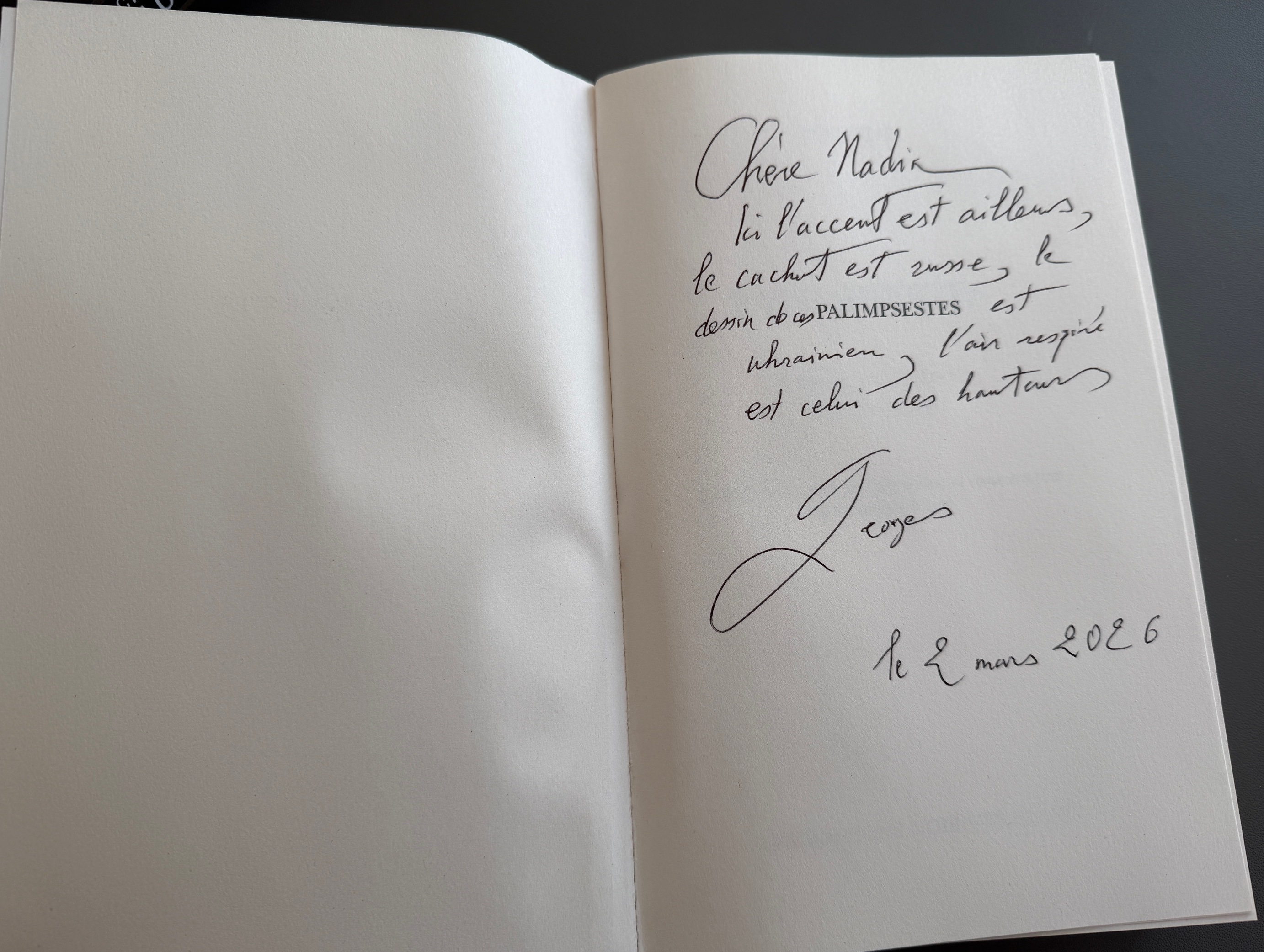
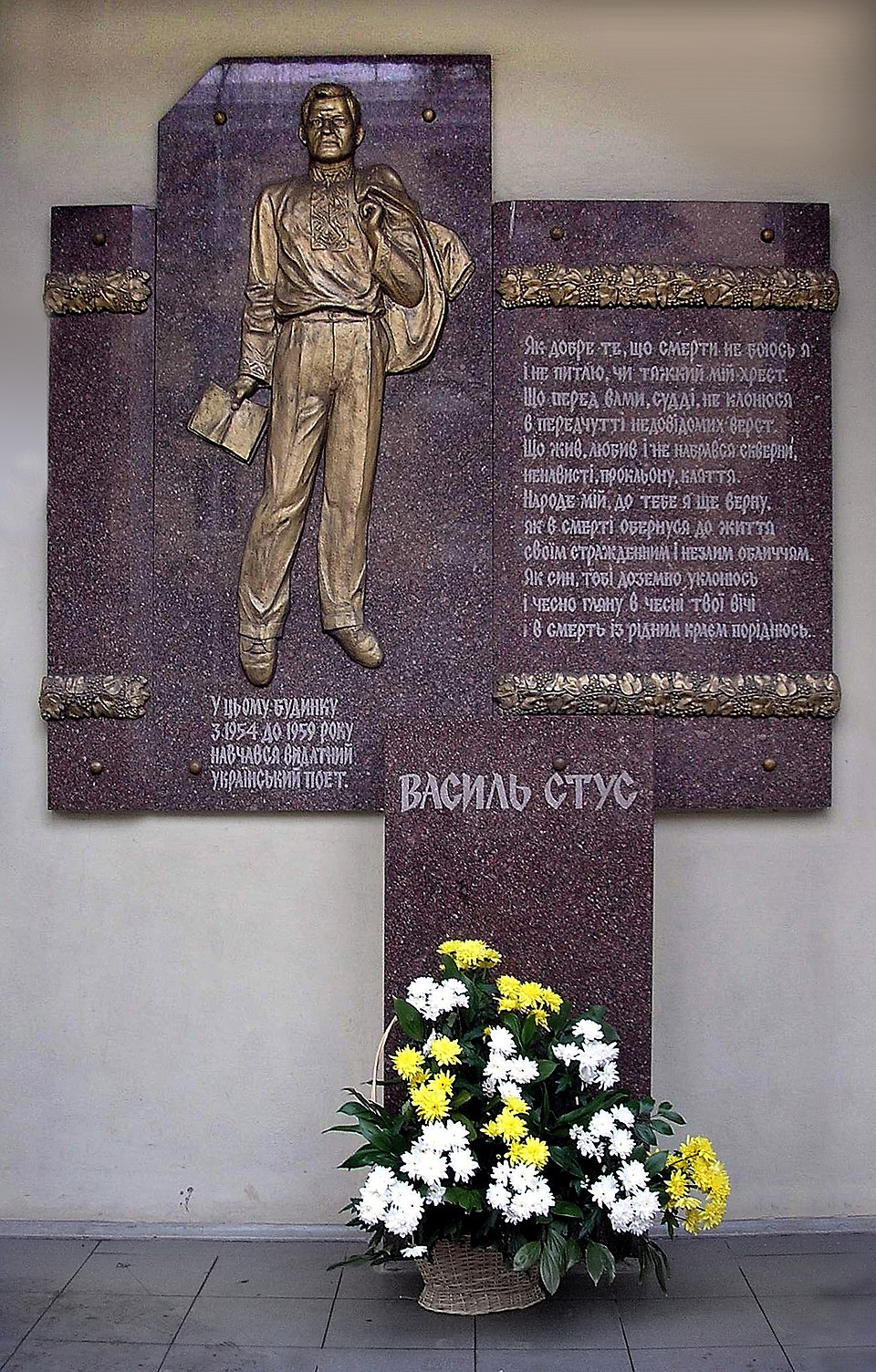
… After reading the book and preparing to write about it, I learned that in 1989 the ashes of Vasyl Stus were solemnly transferred to Ukraine and buried in Kyiv at Baikove Cemetery, and that in 2005 he was posthumously awarded the title of Hero of Ukraine. I also learned that on the night of 5 May 2015 unknown individuals destroyed the bas-relief and memorial plaque to Vasyl Stus on the oldest building of Donetsk National University – the building of the Faculty of Philology where the poet studied from 1954 to 1959. I am sure: the bastards who did this had not read his poems. And I am sure as well: Vasyl Stus would not have called for revenge against them by destroying a monument to Pushkin.
P.S. I am very touched by the attention of Georges Nivat, who sent me the book with a dedication. Would you like to have your own copy? Come to the Geneva Book Fair on 20 March. Georges Nivat will first speak with the Ukrainian writer Andrei Kurkov about what it means to write and translate during wartime, and then he will sign copies. All the details are here. By the way, entry to the book fair is free — you simply need to fill in a form.