
Kyril Zlotnikov: “No one will steer us off our musical path”
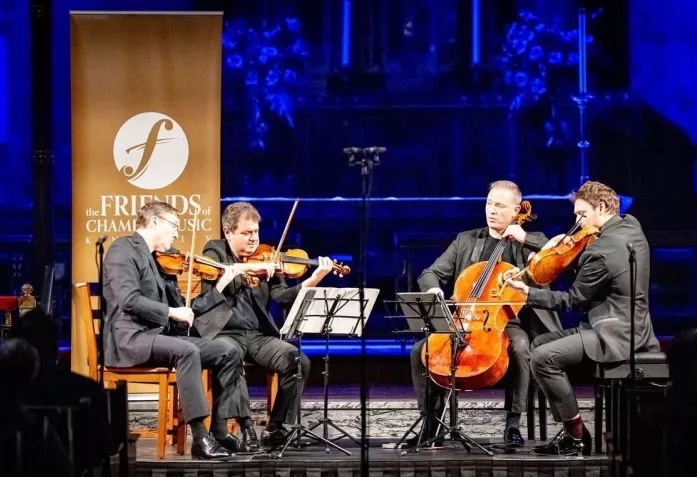
Even the very name of this quartet – which has maintained an exceptional professional standard for more than thirty years – may sound provocative to some, and even incite others to acts foreseen by the Penal Code. That’s why I wish to express heartfelt thanks to the Cæcilia Agency for including the concert of the Jerusalem Quartet in its series Les Grands Interprètes.
But first: who are these musicians?
Violinist Alexander Pavlovsky was born in Kyiv and emigrated with his parents to Israel in 1991. He completed his studies at the Jerusalem Academy of Music and Dance, where his principal teacher was Matvei Borisovich Liberman – himself a pupil of the great David Oistrakh and a former professor in Novosibirsk. Pavlovsky has the good fortune to play two violins: an Antonio Stradivari from 1696, on loan from an anonymous admirer, and a Stefan-Peter Greiner crafted in 2009.
That same year, violinist Sergey Bresler, then thirteen years old, also left Ukraine for Israel and likewise studied under Matvei Liberman. He plays an instrument by the Italian master Lorenzo Storioni, lent by the America-Israel Cultural Foundation – originally a gift from the great violinist Isaac Stern.
Cellist Kyril Zlotnikov was born in Minsk, to the delight of his parents, both professional musicians. The family moved to Israel when he was twelve or thirteen. There he completed his training under the renowned Soviet cellist Mikhail Khomitser, a former student of Sviatoslav Knushevitsky at the Moscow Conservatory and winner of the prestigious Pablo Casals Competition in 1963. Zlotnikov plays a cello by the Amati brothers, crafted in Cremona around 1610 – a priceless instrument lent to him by a charitable foundation.
These three musicians, co-founders of the quartet in 1993, have never left it, though they occasionally perform with other prestigious ensembles. The only “variable element” within the group has always been the viola. The first violist, Amihai Grosz, accepted an invitation from the Berlin Philharmonic in 2010 – and no one could blame him for that.
Today, the founding members are searching for a successor to their current violist, Ori Kam. They have just completed a major tour with Franco-Swiss violist Mathis Rochat, who will also take part in the Geneva concert. Rochat studied in Cologne under Antoine Tamestit as part of the Young Students Program, then graduated from the Mendelssohn Bartholdy Hochschule für Musik in Leipzig under Tatiana Mazurenko. He later earned a diploma from the Queen Elisabeth Music Chapel in Waterloo, where he studied with Miguel da Silva. He now teaches at the Royal Conservatory of Antwerp while pursuing an active solo career.
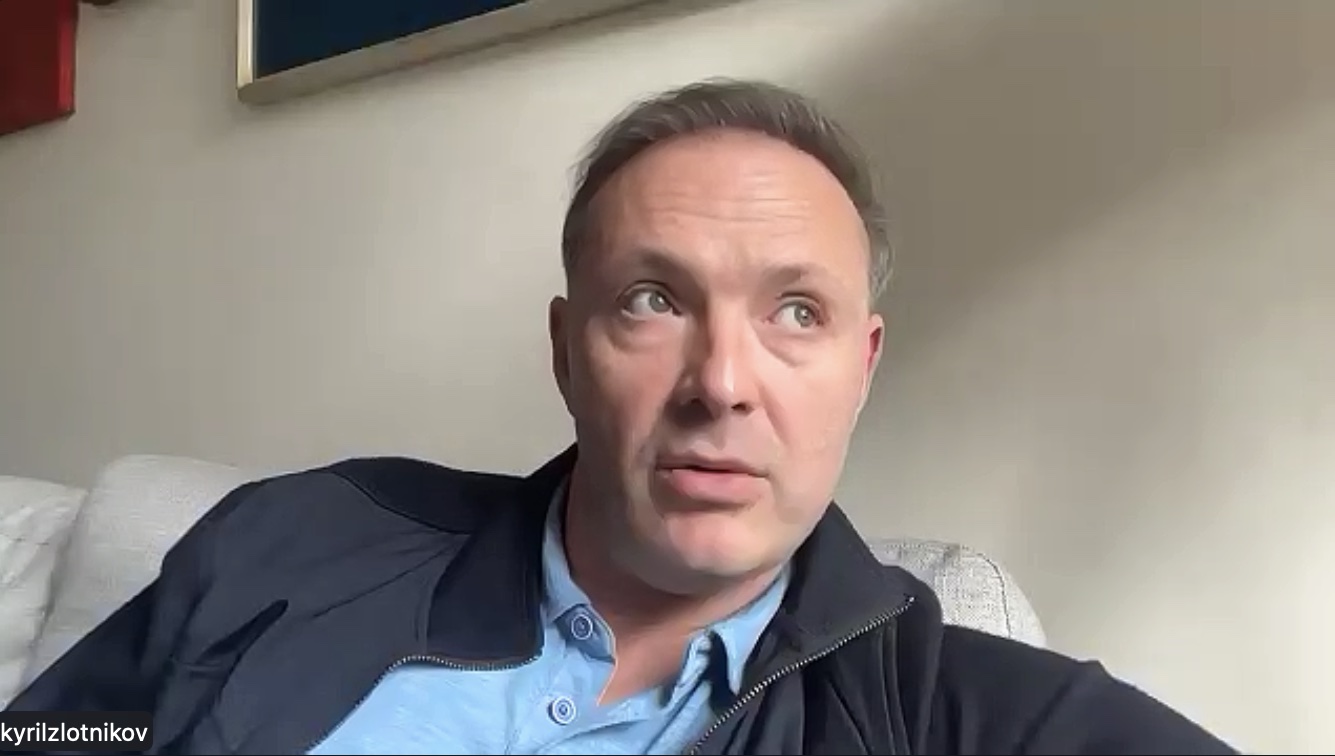
On behalf of the ensemble, it was Kyril Zlotnikov who granted me an interview a few days before the shameful “incident” at the Philharmonie de Paris. The connection is direct, for we began by addressing the most sensitive topic: the question of responsibility for political decisions that some try to place on musicians’ shoulders.
Kyril, you’ve played this year in many countries, including the United States and the United Kingdom. How did your tours go? Have you faced pressure or attempts to cancel your concerts?
Unfortunately, we’ve been dealing with this for a long time – solely because of the quartet’s name. We face a pro-Palestinian organization called BDS (Boycott, Divestment, Sanctions), which calls for the boycott of Israeli products as well as cultural and academic institutions it deems complicit in the occupation or in violating Palestinians’ rights. For years, they’ve organized protests against our concerts. It happened again twice on our recent North American tour. In Vancouver, for instance, about fifty people stood outside the concert hall shouting that we were “child murderers” committing “genocide” – apparently by playing Beethoven and Schubert on ancient instruments...
We first experienced such disruption in 2010, at the Edinburgh Festival. Fifteen years later, this past January, three of our concerts were canceled in Sweden, again because of our name. The police said that “due to the large number of Muslims in the country,” they could not guarantee our safety. When it’s just shouting in the street, so be it. The worst is when protesters buy or obtain tickets and interrupt the concert by yelling during the performance, disturbing the audience.
Two years ago, in May, two of our concerts at Amsterdam’s Concertgebouw were nearly canceled. But with the help of friends, we launched a petition that gathered 17,000 signatures in just two days, including from great musicians – Sir Simon Rattle, Martha Argerich, Mischa Maisky, Anne-Sophie Mutter, Semyon Bychkov, and many others. Evgeny Kissin even threatened to cancel his own concerts at the hall unless the decision was reversed – which helped immensely! In the end, one of the two concerts was “returned” to us; about twenty protesters shouted outside before dispersing.
Another scandal broke out in Amsterdam just in the past few days, when the Concertgebouw decided to cancel the traditional Hanukkah concert – a major event in the life of the city’s historic Jewish community. The reason: the invited cantor, Shai Abramzon, is the cantor of the Israeli army. Many Dutch citizens – not only those of Jewish origin – were outraged, and the international musical community got involved… The matter threatened to go to court. In the end, to everyone’s relief, a compromise was found – it seems that musicians are better at reaching agreements than politicians.
You worked for more than ten years as principal cellist and teacher with the West-Eastern Divan Orchestra, created by Daniel Barenboim and Edward Said. Do today’s events mean the failure of such idealistic projects meant to bring Israelis and Palestinians together?
I wouldn’t call it a failure. The issue is that those who join such projects don’t need convincing, and those who should be convinced don’t attend the concerts, except to disrupt them.
Music can certainly bring people together, but the great crises humanity faces – especially in the Middle East – cannot, alas, be solved by music alone. Deep changes are needed in education and politics... on both sides of the conflict, as well as in Europe.
Enough politics – let’s talk music. You and your colleagues, who left the USSR for Israel, chose to continue studying with teachers from the Soviet school. Why? Was it just a matter of language, or of musical tradition?
It’s definitely a matter of tradition. We all began studying music at five or six within the Soviet system. In Israel, I first studied for four and a half years with Professor Uzi Wiesel; this was a very interesting and formative experience, quite a different teaching style. But when Mikhail Khomitser arrived from Spain to settle in Israel, I joined his class.
In fact, you must take from each school whatever suits you best.
Let’s turn to your Geneva program. It opens with The Sunrise Quartet, the fifth of Haydn’s six quartets, Op. 76, completed in 1797. The title reminds me of the song New Day Will Rise, performed at Eurovision in Basel by the Israeli singer Yuval Rafael, despite attempts to disrupt or cancel her performance. How do you perceive this coincidence?
(Kyril Zlotnikov smiles) Of course, we didn’t build our program around Eurovision, it was planned long before. But this quartet is one of our most performed works and an ideal concert opener. Haydn’s music truly gives the feeling of the sun slowly rising and nature awakening. The first edition of the score even featured a rising sun on its cover – a symbol of hope and renewal.
Everyone knows Beethoven’s Kreutzer Sonata, but you’ve chosen the Kreutzer Sonata by Leoš Janáček, composed in 1923 after Tolstoy’s novella of the same name. Why this choice?
Simply because it’s a magnificent piece. Listening to it – and one can listen to it endlessly –you feel as if you’re reading Tolstoy: the musical colors are of extraordinary intensity. The Sonata moves through contrasting episodes, much like life itself. The audience always receives it enthusiastically, we saw that again on our recent tour.
And Beethoven hasn’t been forgotten! (laughs) The Cavatina alon , the fourth movement of his String Quartet No. 13, a true jewel! It is said that Beethoven wrote it “in tears and sorrow,” and indeed, the emotions that overwhelmed him still move both performers and listeners two centuries later.
As for the Grosse Fuge, originally the final movement of the same quartet before becoming an independent work (Op. 130)... At its premiere, audience was baffled: to ears accustomed to flinching at the slightest dissonance, it sounded like a nuclear explosion! Beethoven’s contemporaries failed to grasp that he was centuries ahead of his time. Even today, the music sounds astonishingly fresh, new, and boldly simple, as if Beethoven were almost teasing us.
Few people know that Beethoven’s Quartet No. 13, which you speak of so movingly, was dedicated to the Russian aristocrat Nikolai Golitsyn, who commissioned three quartets from him. Does such patronage still exist today, allowing contemporary composers to enrich the world’s musical heritage?
Yes, it does. Patrons – and sometimes musicians themselves – commission new works. We recently commissioned a quartet from the Israeli-born, New York–based composer Shulamit Ran; we’ll soon begin working on it. It’s our birthday gift for the quartet’s 30th anniversary!
A few years ago, we also commissioned a piece from Brian Elias, a Jewish composer born in Bombay and living in the UK. A patron financed that commission, and we’ve performed it several times since – it is a beautiful work.
The problem is that many concert organizers hesitate to include contemporary pieces that sound too modern in their programs. And we must admit, in recent decades few composers have emerged at the level of Shostakovich or Bartók. Let’s hope a new creative spirit soon appears!
Thank you for this spirit of optimism – a rare thing these days! And have a wonderful concert in Geneva – fingers crossed!
P.S. Hurry to grab the few remaining tickets for the concert here.