
Alain Blum and Emilia Koustova: "History shows us how unpredictable the future is!"

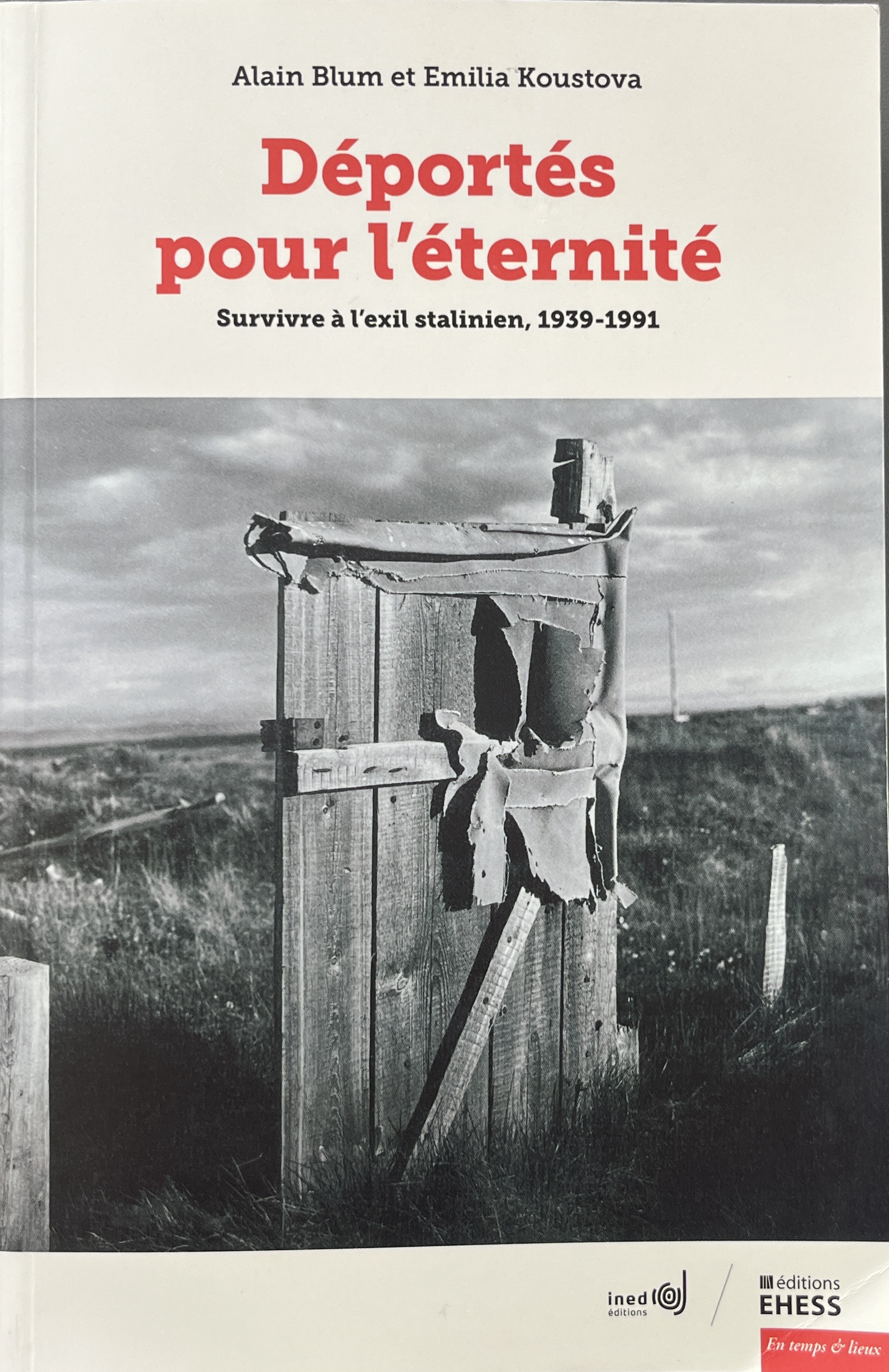
Authors often send me their books, whether literary works or scientific research. Unfortunately, I cannot present them all, which is why I select those that, in my opinion, are likely to generate the most interest among my readers. "Deported for Eternity. Surviving Stalinist Exile, 1939-1991" (« Déportés pour l’éternité. Survivre à l’exil stalinien, 1939-1991 ») is one of them.
The authors of the study "Exiled for Life. Surviving Stalinist Deportation, 1939-1991," French historians Alain Blum (research director at Ined and director of studies at EHESS) and Emilia Kustova (professor at the University of Strasbourg), write in their book's preface: "The war launched by Russia against Ukraine has brought back the old demons of Soviet repressive action." This immediately sets the tone and prompts the first question, to which, like all the following ones, the authors answered together.
Why address this subject now?
This book is the culmination of a project that began with a collection of interviews in 2008. We had then perceived the importance of collecting testimonies from witnesses before they all disappeared. We had also understood the importance of thinking about these deportations as a historical moment concerning all of Europe, whereas the history of Stalinist repressions was often considered as a history specific to the space that was Soviet, a distant and foreign space. However, institutional Europe, the European Union, was in a process of enlargement that made the integration of this past and its memory urgent.
Can we speak of a difference in approach (appreciation of historical events) between you – a Frenchman and a woman of Russian origin? Were there points of disagreement during your work and how was this work organized?
We are both French historians, formed in a historical tradition marked by the Annales school. These common intellectual roots meant that we had, overall, the same approaches, the same way of reading history. Of course, we did not have the same socialization in our respective youths, one in France, the other in Soviet and post-Soviet Russia. In fact, historians cannot completely separate themselves from their personal or family history, which, in Emilia's case, was marked by various repressions and a partial concealment of the tragic past; this history undoubtedly influenced some of her questions. On the other hand, we both experienced the extraordinary opening of archives from the end of the 1990s and the radical revision of the official narrative, experienced by each in their own way, from within Soviet society for Emilia Koustova, or, for Alain Blum, as a young French researcher who began his historian's journey by diving into the Moscow archives of Soviet statistics. These different initial situations led to the same result: the desire, felt by each of us, to better understand and make known this Soviet 20th century in its complexity, its violence, and its paradoxes.
Later, our discoveries of Lithuanian and Ukrainian archives, from 2012-2013, undoubtedly reoriented our perspective, regardless of our origins. We then began to work, first each on our own, then together, on a history of Stalinist deportations that we wanted to place at the crossroads of several approaches, scales, sources: a history lived from below and from above, grasped through the voices of witnesses and police archives, observed at the scale of the Soviet state and at the village level. Once we formulated this project to write a four-handed work, everything happened quite naturally: we shared the same interpretive framework and a good number of questions, to which could sometimes be added interrogations that were specific to one or the other, coming from their previous professional experience and sometimes from their lived experience. Thus, Alain Blum put his demographer and statistician toolkit at the service of this project, but also his interest in individual trajectories and their inscription in space, while Emilia Koustova showed herself particularly sensitive to the material environment of the deportees.
How did you meet Naum Kleiman, more often cited in the cinematographic context than the political-historical one? What is your impression of him as a human being?
To tell the truth, this type of encounter is part of the happy unexpected events of research. It was through a colleague, now a CNRS researcher (Irina Tcherneva), who was then working on Soviet documentary cinema, that I (Alain Blum) learned about Naum Kleiman's journey. We also knew his daughter, an interpreter at the French University College of Moscow, who put us in contact. It was a discovery, and the interview, conducted by Irina Tcherneva and myself (Alain Blum), remained anchored in our memories, so fascinating was this character, of very great sincerity and humanity. He had received us in the Eisenstein apartment-museum, of which he was a very great specialist, which added even more to the emotion.
While sympathizing with displaced peoples, you mention only very briefly, in passing, the role of Lithuanians and Ukrainians in the extermination of Jews. Why?
First of all, as researchers, we would not speak of sympathy, but rather of a history that touches the human. Regarding your question, the history of the extermination of Jews is naturally an immense, essential history, and the question of the participation of the populations of Ukraine and Lithuania is of course part of it. But, and we understood this well while working on forced displacements, it is not directly linked to these deportations. Stalin launched the first repressive wave in the territories annexed following the Molotov-Ribbentrop pact in 1940-1941, before the Shoah, and these deportations also affected Jews from the Baltic states and western Ukraine. The Soviet mass displacements of the post-war period do not constitute – with rare exceptions – a war purge but are part of the fight against anti-Soviet insurrection and the forced collectivization of Baltic and Ukrainian agriculture.
The history of the Shoah in Ukraine and Lithuania is today profoundly renewed thanks to the unrestricted opening of the archives of these countries (unlike the archives of the Russian Federation). We think in particular of the SBU archives in Ukraine and the Special Archives of Lithuania (LYA). We also work on these questions, as evidenced for example by Emilia Koustova's article, published in the Revue d'histoire de la Shoah, which directly addresses these questions. We were also interested, in a recent article, in the repressions carried out by the Soviet regime against Holocaust survivors in Lithuania. These questions are also at the heart of the current research that I (Emilia Koustova) am conducting in Lithuania.
You speak (p. 61) of "changing labels" that continues to this day. Do you think the West should have reacted more actively to the glorification of Bandera and Petliura in Ukraine in order to deprive President Putin of these "trump cards"?
Above all, we do not think that Putin really needed these glorifications to develop his discourse of hatred against Ukraine and thus justify his aggression. If there had not been Bandera, he would have found something else or would have limited himself to brandishing the threat that would come from NATO while continuing to falsify to his entire profit the history of the Second World War and its aftermath.
Undoubtedly, the writing of history in Ukraine, subject since 2014 to the Russian threat, has partly been done in search of heroes, as was the case in many other countries, in the 19th century or more recently. And as everywhere, this quest tends to retain only the heroic dimension, in this case their struggle for independence, while concealing their possible dark side. We cannot, of course, accept the glorification of people involved in the Shoah and in any mass crime, whether perpetrated by the Nazi or Stalinist regime, by nationalist movements or colonial states, whatever action these figures may have taken elsewhere. One of the roles of historical research is to shed light, harsh if necessary, on the entirety of their action, including by contradicting what the national narrative seeks to promote as a heroizing and sometimes forgetful account of the past. Here, it must be emphasized how active Ukrainian historians are in their desire to renew the history of their country by working rigorously and without concealing the dark sides, and how archivists are doing incredible work to support this effort, all under the daily threat of Russian attacks.
We believe that the best response that European countries can provide (we prefer to avoid the term "West," which does not correspond to the realities of the current world and which is, moreover, widely used by Russian propaganda to impose the idea of a "clash of civilizations"), consists of supporting the project of Ukraine's integration into the European Union, as well as supporting pro-European forces within the country. The latter defend democratic values and seek to take a lucid look at their country's past. They favor an open discussion of it, without fearing to highlight a reality more complex than that presented by far-right forces. It is impossible to impose a "historical truth" from the outside, but it is essential to support those who, within the country itself, strive to study and debate history in a serious, critical, and honest manner.
The process of de-Stalinization is far from finished in Russia, quite the contrary. How do you explain this?
This process probably did not go far enough at the moment that was most conducive to such a reexamination of the past, in the 1990s. Despite the essential work carried out by civil society actors, primarily Memorial activists, and by historians of great talent, lacking true political will, it was neither systematic enough nor sufficiently deep to address, involving a broad public, the most painful questions, those concerning the responsibilities of the Russian state, including towards other nations or non-Russian ethnic groups. Writing one's own history, marked by great violence, is always difficult and takes time (see the difficulty, even in France, of writing the history of colonization and decolonization). The difficulties are even greater, even insurmountable, when political obstacles stand in the way of this work.
Russia had thus not sufficiently entered into this writing, when a new authoritarian power emerged, leading to the resumption of the narrative of a great power with a glorious past. From the 2000s, the writing of a history glorifying victory over Nazism was accompanied by the rehabilitation, even glorification of Stalin himself, putting all the violence of Stalinism in the shadows. This personalization is characteristic of any authoritarian power, such as that of Vladimir Putin, who seeks to further establish unlimited authority on historical figures presented as heroes and of whom he would be the heir, allowing him to construct, like Stalin, the image of a living "Great leader." With the beginning of aggression against Ukraine in 2014, then a confrontation with the "collective West," an image constructed entirely by Russian propaganda, this revisionist process has further accelerated, carried among others by an increasingly broad use of the repressive tool.
How did you react to the opening of the monument to Stalin at the Taganskaya metro station in Moscow on May 15, 2025?
We were not entirely surprised, given a trend that began well before. Let us recall that the Kurskaya station had already seen, it too, one of its exits adorned with a Stalin quote, under the pretext of restoration to the original. But, if it was not a total surprise, that does not diminish the violence of the effect produced.
Historians do not like to predict the future. And yet, how do you imagine the end of the war in Ukraine?
As you say, we do not predict the future. It is not a matter of liking or not liking to do so. History shows us how unpredictable the future is! We try to draw, from this unpredictability, a little optimism, despite an extremely difficult situation. The courage shown by millions of Ukrainian civilians and soldiers, for more than three years, imposes on us a duty of hope. Duty of hope for Ukraine of course, but also duty of vigilance in the face of the rise of far-right movements in Europe, favored by Russia. We fear that this effort to destabilize unified Europe, which constitutes one of the obvious goals of the Kremlin, may partially succeed, when we all need, more than ever, a strong, free Europe, which resists ultra-conservative discourses denying the social evolutions of recent decades, and which refuses any form of colonial or imperial resurgence.
Several specialists who have devoted their lives to Russia – its history, culture, etc. – feel betrayed today and tell me that Russia's future hardly interests them. And you, does it interest you? How do you see it? Do you think that one day the Russian people will break their deafening silence?
Do we feel betrayed? We do not think the word is appropriate. We became interested in a history of great violence, and we see that it continues, sweeping away the hopes that emerged at the end of the 1980s and that we shared with so many Russians, but also Ukrainians, Lithuanians, Kazakhs or Armenians. We observe with sadness and anger (the word is weak) this rise of authoritarianism, of extreme conservatism, of this unlimited violence carried against Ukraine and its population.
Russia's future interests us of course, as does the future of Europe, Ukraine, Lithuania. As historians, we have ourselves, for many years, turned our gaze to these last two countries, inscribing ourselves in a movement often evoked today, of decentering, essential for writing a history that is not focused on the glorification of an imperial and colonial past.
And what about the Russian people or rather the population of Russia? It is manifestly diverse, yesterday as today. From the mid-1980s, a whole part of society reacted, spoke and contributed to a new dynamic, forcing the authorities to go much further in their opening, initially very timid. When on the contrary, an authoritarian power, become dictatorial and ultra-conservative, took charge of the country's destiny, undoubtedly another part of society placed itself in the foreground, and contributes today to this silence, indeed, deafening.